








By IRA PORTER
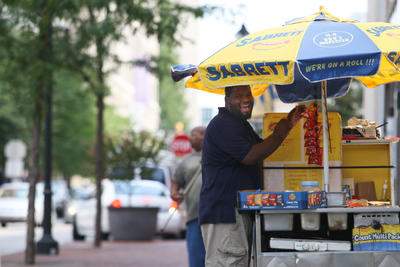
Earvin Griffin casts an imposing figure outside the Grand Opera House in downtown Wilmington.
His thick, six-foot frame is dressed in a navy blue Ralph Lauren polo shirt, tan cargo shorts and a blue Washington Nationals baseball cap. His low-top Nike sneakers have straps instead of laces.
Shortly after 11 a.m. his workday starts, and Griffin, 21, launches himself into the first of his two jobs.
He walks to a truck with a vending cart attached and spends 15 to 20 minutes loading ice, sodas, packs of hot dogs and sausages into coolers. It’s midmorning. The streets are quiet. But blue- and white-collar workers, free for lunch, will soon enliven the sidewalks. As they stroll by Griffin, it’s clear from the banter that they know and appreciate him.
Before the lunch rush, Griffin takes time for breakfast, a $1.25 bowl of Frosted Flakes and half pint of milk.
Everybody seems to know him. Well-dressed businessmen and businesswomen say hi. Others dressed more like him stop to give him a handshake and talk rap music. He flirts with as many women as he can.
“When I come up here, we just zone out [and have a good time],” said Griffin, known by most as Swearv.

His body is decorated with eight tattoos, some of which feature his nickname, his mother’s nickname, the name of a cousin who died and a rest in peace shout-out to his Aunt Sugar, who died of lung cancer. That one reads, “Through all the struggle, the hassle, survive against all odds.”
“I told myself that I would never smoke cigarettes,” he said, minutes before sticking a cigarette behind his left ear.
Griffin is part of a 15-member team of researchers chosen by the Wilmington Hope Commission and University of Delaware to participate in an 11-month project led by assistant professor Yasser Arafat Payne.
The project uses Participatory Action Research (PAR) methodology, which has local workers conducting advanced-degree-level research on the streets of the East Side and Southbridge neighborhoods.
Griffin and his colleagues were taught research methods, conducted field interviews, created and handed out an 18-page survey, contributed to journal articles and produced arts components, including a soundtrack, public service announcements and a memorial video for the city’s homicide victims.
Payne said 150 people applied for the jobs.
“We were looking for very inquisitive people, even if they didn’t have a formal research skill set. We were looking for social activism experience, because this was an action project. Between intellectual interests and community interest, we think we were able to select 15 people that fit that criteria,” Payne said.
 He said they were looking for people who were open to the idea of going to college.
“That was really important,” he said. “Some of the members in our group do have college experience and have actually graduated. One of the things we could promise with UD, Wilmington University, DelState and DelTech on board was we could get them scholarship money for participating in a project like this.”
Payne could not stop talking about Griffin’s contribution.
“He’s a renewed spirit,” Payne said. “He’s our youngest, so he keeps us grounded.”
Griffin says he is grateful for the work and the experience, but he has bigger plans.
“I want to get inside of a [music] studio so bad,” he said between serving customers.
Griffin has notebooks full of poems and rap lyrics that he started writing in middle school.
“I think a lot about my music,” he said. “That’s what I need to stay calm.”
 ‘I just learn to deal with it’

In front of an audience, Griffin transforms from researcher and hot dog vendor into a gritty emcee who raps about the insecurities of having no money, standing tall when others abandon him and summoning the courage to approach an attractive woman.
“I’m an artist in every way,” said Griffin, who says he listens to everything from rap to rock to heavy metal. “People feel you more when they relate to you.”
Griffin performs the second and fourth Thursdays of the month at the Indigo Lounge in a program presented by Hippy Maphia, a Delaware group of musicians. From 8 p.m. to midnight, the top-floor lounge in a building in the first block of W. Fourth St. showcases local musicians, poets, rappers and singers.
The loud music reaches people on the street below; some are smoking, others are taking a break before they perform.
Griffin is working on a mix tape that he hopes will hit the streets soon. He also has completed a song for the PAR soundtrack, titled “Broke.”
“I just hope he gets what he wants,” said his grandmother, Sara Griffin, 71, motioning toward music pulsating downstairs.
The basement of her Rutledge home is Swearv’s. Exposed water pipes run across the ceiling. Bare concrete makes the walls. A clothesline stretching across the room serves as his closet, supporting dozens of designer shirts.
His bed is in the far corner, little more than a mattress on the concrete floor. On top of the bedspread, a white teddy bear lies face down. On the wall, a tattered poster of Mickey and Minnie Mouse is decorated with signatures of friends.
At the center of the room is his computer, where he spends most of his time listening to music and writing songs.
“He’s really good with computers. That’s what I would want him to do, but he’s really into his music,” said his grandmother, who admitted she does not have the patience for loud music.
“My grandmother sees the brighter side of things,” Griffin said. “That’s the way she lives her life.”
In addition to being Griffin’s biggest supporter, his grandmother may be his only supporter in the family.
“If my grandma didn’t come to the rescue as many times as she did …,” he said, trailing off. “With no male figure, me and my little brother are only one year apart, so we got into a lot of trouble together. It would have been worse.”
Sara Griffin raised him for part of his childhood.
Griffin finished night school at James Groves High School after being kicked out of William Penn High School at 17.
 “My mom is always talking about why don’t I be like my older brother, because he went to college and everything. I don’t get support,” he said. “I don’t get it from my mom, but I got it for myself.
Griffin has to deal with his younger brother, who was charged with murder, according to court records.
The optimism in Griffin’s voice does not change, whether he is talking about his music, his brother charged with murder or the violence around him every day.
“Honestly, you can’t stop it,” he said. “It’s just going to keep going on. I just learn to deal with it.”
“I can’t stop bullets with my hands. I just stay to my section and worry about my little sisters.”
Part of his experience is reflected in an 18-page survey that the PAR team gave to East Side and Southbridge residents that has a section dedicated to violence. Griffin helped form those questions with fellow researchers.
One of the questions asks, “When was the last time you heard about someone getting shot with a gun?” The answers range from about a week to more than five years.
It makes Griffin think of his brother.
“He was hanging with the wrong people,” Griffin said. His mother stresses about his brother facing jail time, Griffin said, and she transfers stress about the legal battle to him.
“My PAR money goes toward that,” he said of the $600 he got a month. It was paid to his brother’s attorney.
New doors opening
Griffin doesn’t want to go to college.
“That’ll just be one more cost for me,” he said. “I already owe money.
“I’m not a good payer-backer, if that’s a word.”
“I see myself in a lot of their shoes,” he said of people interviewed for the project. “It’s rough. The survey showed a lot.
“We don’t get the same opportunities as these white collars, being able to go on trips, travel and all that. That’s stuff we dream about.”
Through PAR, Griffin was given a glimpse of a collegiate atmosphere, including research skills and a tour of a university museum, which featured an African-American exhibit. He also has interacted with professionals and academics that normally would fall outside his social circle.
“I meet all kinds of people there,” he said. “We go there and have wine and cheese.”
Payne is still hopeful Griffin will go to college.
“I think he’s very talented, charismatic and gifted. He’s very hardworking and dependable. In the group we said we’re a family, and he definitely took that seriously.”
Payne said group members are still working on Griffin, trying to find him a job and educational opportunities.
If his experience with the project works out as promised, it could help Griffin further his career. But all that would have to wait until he gives music a serious try.
He realizes that might mean leaving Delaware — the only place he has ever called home. But leaving means freedom.
“I would go to Miami or like an island. I’m a vision seeker. I love great views.”
Contact Ira Porter at 324-2890 or iporter@delawareonline.com.