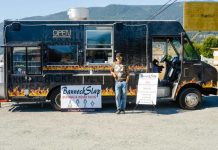






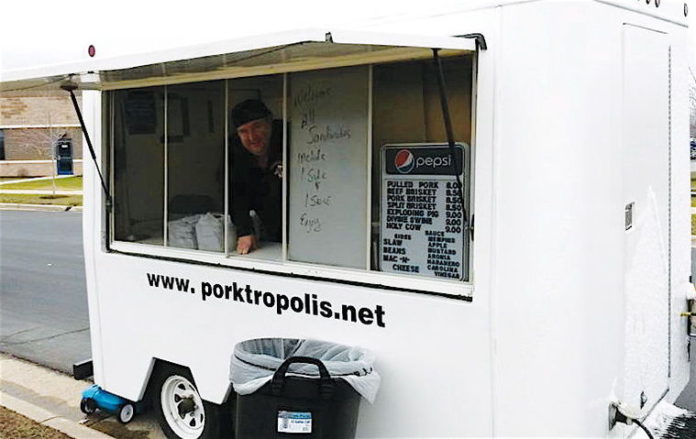
Todd Dukes from Porktropolis aims to make wider use
of his food cart in Sun Prairie if fees are reduced.
Dukes, who takes his cart to several Madison area communities,
called Sun Prairie’s fees “unrealistic” during a Tuesday meeting.
By Jennifer Fetterly | The Star
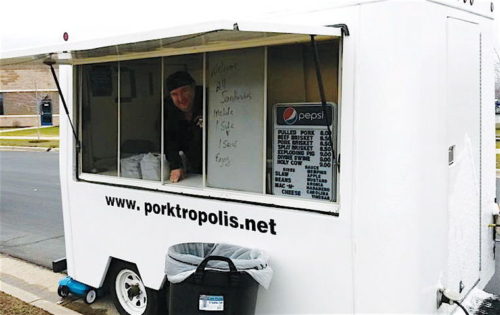
Todd Dukes from Porktropolis aims to make wider use of his food cart in Sun Prairie if fees are reduced.
Dukes, who takes his cart to several Madison area communities,called Sun Prairie’s fees “unrealistic”
during a Tuesday meeting.
They’re a common sight in other urban areas but so far Sun Prairie hasn’t caught on to the food cart trend. But that may change as city officials mull over ordinance revisions that would allow culinary caravans but still keep the peace with brick and mortar restaurants.
Nationwide, food carts are booming in popularity because they offer quick, diverse meals at low prices.
Local restaurateur Todd Dukes has operated a food cart for two years as an offshoot to his Sun Prairie barbecue joint, Porktropolis. But while he’s fed hungry fans all over Madison and other suburbs, his cart has never hit Sun Prairie streets.
The reason? It’s just too expensive.
“The licensing fees that the city is charging are too high and unrealistic,” Dukes said in a Tuesday phone interview. “They are double what other municipalities are charging.
The current solicitor’s permit fee is $300 annually, $65 per month, and $30 per week, plus background check fees.
Under a proposed draft, the fees would be cut to $150 for the mobile food vending unit and a $25 fee for each mobile food vendor.
Dukes said those are reasonable and more in line with other municipalities’ fees and voiced his support to Mayor Jon Freund, which is how it came up on the March 17 Committee of the Whole agenda.
But during discussions at the council’s March 17 Committee of the Whole meeting, alders were split on how to move forward on ordinance changes in order protect other businesses and the community.
Freund said vendors could be situated around parks that don’t have food serving options nearby, and people could picnic or eat while watching sporting events.
“This is certainly something that could be an asset but we need to make sure it’s not a negative for our brick and mortar restaurants and stores,” Freund told the council.
The mayor said regulations need to address where carts can park, how many and how long. City officials also want to make sure fees are enough to bring in revenue and pay for extra staff costs.
District 3 Alder George Frank said he doesn’t want to see food vendors “take the dough and run” by setting up during nice weather and selling, while other businesses pay rent, property taxes and offer year round employment.
“This is a dramatic thing,” Frank said. “Somebody could walk out and pay $2-3 for food and down the street someone who is paying thousands of dollars on rent doesn’t get that money. I want to make sure it’s fair and balanced.”
He wants restaurant operators to be made aware of the ordinance changes the city is considering and get their feedback.
District 2 Alderperson Andrea Gage supports bringing food trucks to the city because it offers more choices to consumers. She said when she worked around the State Capitol she liked to have a choice of grabbing something quick or eating at a sit-down restaurant.
“The presences of both options didn’t really deter me from doing one or the other, “ Gage said, and favored consumers deciding. “We don’t want too heavy a hand on the market. I think that the marketplace will see to it if this is something that is welcomed in our community.
She also pointed out that the two businesses that have showed an interest in food cart vending– Porktropolis and Beans ’n Cream — have brick and mortar establishments in the city.
Dukes said other vendors and he don’t want to compete with restaurants but would be interested in vending in parks or near businesses that have a lot of employees who can’t leave for lunch.
If the city ordinance is changed, Dukes said he could bring other food carts to the area as part of his membership with Let’s Eat Out. The non-profit food cart vendor association holds dinner events that rotate through neighborhoods in Madison, Monona and other suburbs.
According to a recent National League of Cities report, mobile food vending generates roughly $650 million in revenue annually in the U.S. and is projected to reach $2.7 billion in the food revenue during the next five years. In comparison, restaurant industry sales in the U.S. are project to reach $709 billion in 2015.
The report also found that most city ordinances were antiquated, based on pricing by ice cream trucks and hot dog carts, and didn’t address future expansion of the food cart industry.
But the clock is ticking for the city to make ordinance changes.
Food vendor season usually starts in April and most food carts are already setting their calendars for locations. Council members fear lengthy delays may leave Sun Prairie off the food vendor’s menu.
City officials aim to hold a public meeting regarding the ordinance within the next two weeks in order to get feedback about the changes.