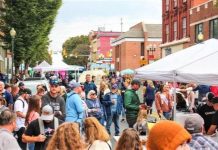
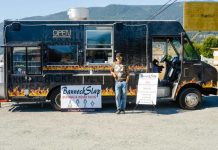
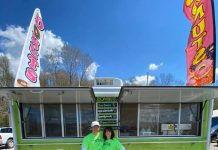

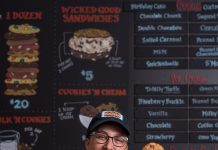

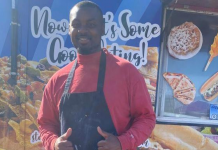


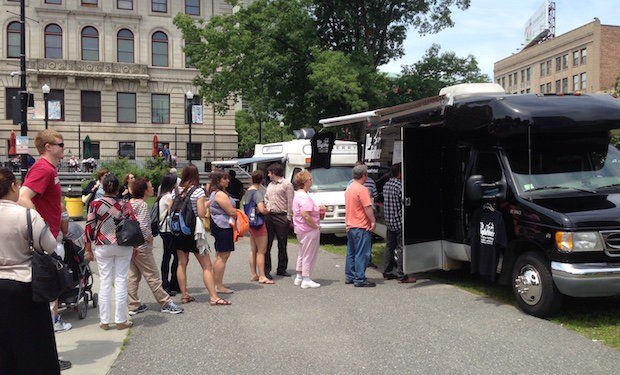
could see them as a regular part of the city's downtown commerce. (Michael D. Kane | MassLive)
By Michael D. Kane | MassLive.com
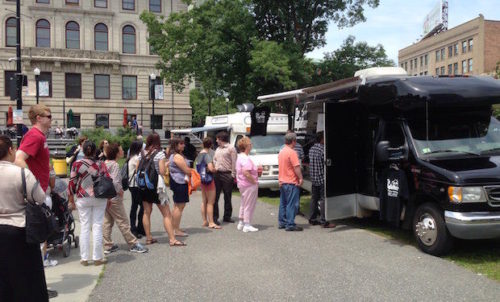
could see them as a regular part of the city’s downtown commerce. (Michael D. Kane | MassLive)
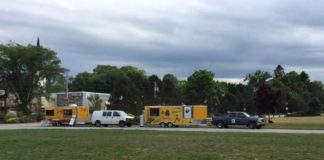
WORCESTER — Ever want to finish off a walk around Green Hill Park with sausage and peppers? Worcester City Manager Edward Augustus Jr. over the coming weeks will begin a public feedback campaign via the city’s website and social media platforms to solicit feedback on where residents would like to see food trucks in the city.
Augustus this week revealed a proposal that would create an updated process for street vendors and food truck owners to apply for licenses. It also calls for food truck zones on the City Common and at Elm Park, but those locations are neither approved, nor are they the only options avaiable, he said. Thus the desire for more feedback.
In addition to where food trucks could go, the city also has to determine hours of operation and frequency of health inspections, a letter to the City Council states from Economic Development Director Michael Traynor.
But Augustus’s plan has been met with a call for caution. The City Council had previously restricted food truck operations within the city, based on complaints from so-called brick and mortar businesses.
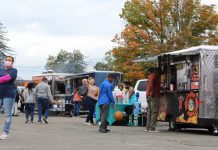
Augustus said it is time to reconsider that action, pointing to last week’s Food Truck Festival at Elm Park that he said not only was attended by Worcester residents, but brought people into the city who then went on to visit other businesses.
The idea also allows for more entrepreneurship for people who may want to try their hand at a business prior to opening in a permanent location, he said.
“Around the country plenty of cities embrace food trucks,” Augustus said. “There ought to be a place for people who want to embrace entrepreneurship and try (selling food items) and see what the response is.”
In an ironic twist, Augustus wants to solicit feedback electronically for the first time, an idea that has more than once been pushed by At-Large Councilor Konstantina Lukes. But Lukes was one of the city councilors this week urging caution as the plans evolve.
Lukes, who also supported the tighter restrictions placed on food trucks in 2008, noted her family has operated restaurants in Worcester. She said the food industry, despite being glamorized on reality television, is a tough industry in which to make a profit.
“There are compelling arguments on both sides,” Lukes said. It’s not easy … out of a brick and mortar to operate a restaurant. I’m not sure the folks who will respond understand the difficulty of operating a food establishment.”
She was echoed by District 1 Councilor Tony Economou, whose family also operated restaurants, but who also described the idea as progressive.
He said the restaurant business is always challenging, but that having a food truck court would draw people downtown “out of the buildings and onto the street.”
Ultimately, Economou said, having food trucks might lead to more brick and mortar restaurants in Worcester if successful vendors want to expand.
District Two Councilor Philip Palmieri said the two sides have “more in common than not,” calling the issues raised in the discussion minor. He urged the matter to be handled quickly.
It is possible that the new regulations will be in practice by this summer.
Chairman of the Economic Development Subcommittee Frederick Rushton said he would place the matter on the committee’s July meeting, with the expectation to have a recommendation for the full council after that meeting.
Responding to concerns about existing businesses, Augustus said Americans live in a market economy, and the market, not the city, should influence competition among businesses.
“We are not trying to push anybody out, but we do live in a marketplace,” Augustus said. “In a city this size, I think we have a few more opportunities for food trucks.”
He was supported by District 5 Councilor Gary Rosen, who said he opposed the increased restrictions seven years ago.
“I don’t know if it is the governor’s job to inhibit competition,” Rosen said. “I really do believe that vote we took several years ago was the wrong vote.”
At-Large Councilor Morris Bergman urged more discussion on the matter. He said he agreed the trucks could create more foot traffic, but also cautioned that allowing too many trucks in one location would mean none truly become successful. Some of the city’s restaurant owners have invested in their properties, and the neighborhoods, he noted.
He said the plan, as written, “is riddled with the potential of lots of unintended consequences.” There is nothing saying what the process will be for granting a license, he noted. How many will be issued? Will there be a lottery, or some other determination for granting a license? he asked.
Augustus, however, said the city was not “reinventing the wheel.” Both Boston and Providence have vibrant food truck courts, and publicly available rules and regulations, which Worcester has researched, he said.
“We have a lot of retail corridors throughout the city and we never say, ‘gee, when are too many retail businesses too many?’ ” Augustus said. “I think we let the market sort that out.”
http://www.masslive.com/news/worcester/index.ssf/2015/06/worcester_wants_to_know_where.html