Entrepreneurs use stalls, trucks to grow businesses cheaply
Kevin Rosenberg never planned to become a street vendor. Inspired by the backpacking trips he once arranged for his fellow students at Cardozo law school, he started his business, Gear To Go Outfitters, as a website in early 2009. But after nine months, Mr. Rosenberg said, he realized that the company “-wasn’t growing like I needed it to.”
So he hit the streets. His status as a veteran—he served two tours in the Navy—qualified him for a hard-to-get New York street vendor license. Now, in addition to his website sales, he hawks outdoor equipment out of his Honda Element on Seventh Avenue in Park Slope, Brooklyn. The 37-year-old owner, who continues to arrange all-inclusive hiking trips, reported “180% growth” for Gear To Go Outfitters in 2010.
His master plan includes opening a storefront in the neighborhood and building a national brand to rival EMS, “except that all the employees in my stores would be licensed guides,” Mr. Rosenberg said.
Most street vendors in the city are immigrants just trying to make a living, according to a study by the nonprofit Urban Justice Center. But a new crop, challenged by an economy in which expansion capital is scarce, views merchandise stands and food trucks as business incubators with the potential to grow into local or national brands.
“Some folks are realizing that these are viable businesses,” said Sean Basinski, a lawyer who runs the Street Vendor Project at the center, which provides legal services and other support to local residents. Few succeed in creating a well-known identity, “because it’s a big jump,” Mr. Basinksi said.
Beer and chocolate
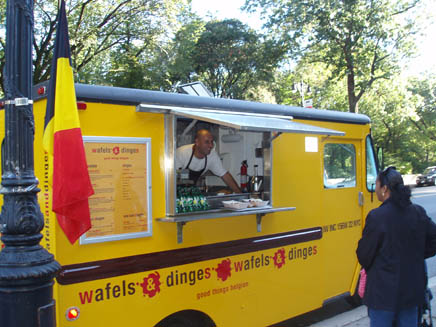
Thomas DeGeest is trying. In 2006, the native of Belgium chucked an engineering career at IBM to start Wafels & Dinges, selling topping-laden Belgian waffles and other gourmet desserts out of a truck downtown. He now has five vehicles and nearly 25 employees.
To further expand the enterprise, Mr. DeGeest sells Belgian products such as chocolate and beer on the company’s website, and offers catering services. He also envisions drive-through waffle restaurants in New York and Los Angeles.
“I want to make them like In-N-Out Burger,” Mr. DeGeest said.
Meanwhile, his truck business remains a growing concern. With each vehicle generating $1,000 to $1,500 a day, total sales are projected to reach more than $2 million this year.
Cheikh Fall’s experience as a street vendor may be more typical.
An immigrant who grew up in the Ivory Coast and later served in the U.S. Navy, Mr. Fall began selling bags, hats and sunglasses outside Bloomingdale’s in Manhattan eight years ago.
He figured that he would do the street gig for about a year, but it continued. Eventually, Mr. Fall began importing unique, Italian-designed handbags that his regular customers had requested.
Finally, Mr. Fall saved enough to open a shop specializing in similar merchandise in a Harlem storefront last August. The shop, on Frederick Douglass Boulevard, is called Ob’Prama, after Barack Obama and Oprah Winfrey.
Mr. Fall dreams of having another shop location. “I can’t afford Times Square, but I’m very hopeful,” he said.
Conversely, entrepreneurs with traditional locations are turning to rolling outposts to grow their brands inexpensively.
The owners of Red Hook Lobster Pound had been selling Maine lobsters from a store in that neighborhood for two years when they began offering fresh lobster rolls at a stand in the Brooklyn Flea Market in 2009. The savory treats quickly garnered hundreds of fans.
Growth plans
Founders Susan Povich and her husband, Ralph Gorham, are now looking for another entrepreneur to partner with to procure a Manhattan street vendor license. They have also set up a food truck in Washington, D.C., and plan more trucks in other cities along the Eastern seaboard.
Red Hook Lobster Pound had 2010 revenues in the “seven digits,” said Ms. Povich, who forecasted 50% growth for this year. And, she boasted, the company doesn’t have “a dime of debt.”