









By Jon Whiten | JerseyCityIndependent.com

After weighing changes to its food-trucks law for more than two years, Jersey City is finally set to revise the ordinance, with a bill being introduced to the City Council this week.
The proposal is wide-ranging and would change everything from how food trucks and street carts are legally defined, to how many licenses the city can issue, to how long vendors can stay in one place.
“[The changes are] focused on striking a balance between the concerns of the vendors and the residents who wish to continue purchasing food from the vendors, on the one hand,” assistant corporation counsel Aurelio Vincitore writes in a April 21 memo to the City Council. “On the other hand, the city had to consider placing controls in the licensing process to insure that future irregularities in the administration of licenses would not occur again, protect the health and welfare of those purchasing food from said vendors, place provisions in the ordinance to curtail disruptions in the flow of pedestrian and vehicular traffic caused by those wishing to purchase food from said vendors, limit the hours of operation, and make the ordinance as clear as possible to assist those charged with enforcing its provisions.”
The current law, which dates to 1971, prevents food trucks from remaining in a given location for more than 20 minutes. In the two years, a number of vendors have consistently alleged that the law is obscure and selectively enforced.
Further complicating the matter is the July 2009 arrest of health department official Joseph Castagna for allegedly issuing illegal vendor licenses (Castagna has since retired). The current law caps the total number of licenses in Jersey City at 175, but the city now says 322 licenses are currently in circulation. Because of the difficulties in figuring out which of the extra licenses were issued legally and which weren’t, the proposed revisions to the law allow all 322 licenses to be renewed, in order to protect the city from potential lawsuits. But the changes would limit the number of license transfers to 175, in an effort to “gradually reduce the number of active licenses.”
The revised law would create two distinct classes of mobile food vendors — “food catering devices,” or push carts, and “itinerant food catering trucks.” Both classes of vendors would now be allowed to operate in Jersey City only between the hours of 6 am and 9 pm, and both would face regular health inspections.
In addition, push carts would be forced to move at least 300 feet every hour, and food trucks would have to move at least a quarter of a mile each hour. Food trucks would also be prohibited from operating within 300 feet of any bricks-and-mortar food or drink establishments, and within 100 feet of another licensed truck. Both the carts and the trucks would be banned from most of the Newport area, and the trucks would also be prohibited in all of the city’s Special Improvement Districts.
Jason Scott of The Taco Truck says he is glad the city is finally moving on revising this legislation, but to him, some of the details of the bill don’t seem realistic.
“I’m happy to see that they are making progress and trying to address this issue, but I don’t see how this is going to work,” he says.
Specifically, Scott says the one-hour time limit is problematic, since “it takes most of us 20 or 30 minutes to just set up.” He also says that it doesn’t seem to make sense to limit the density of trucks and enforce a 100-foot distance.
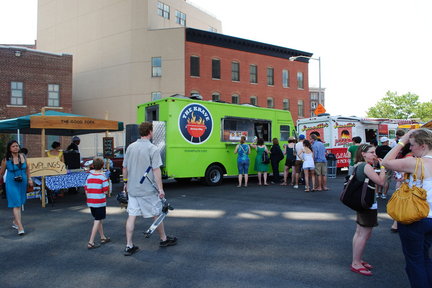
“We operate fine being close to each other,” he says, pointing to the popularity of the mini food-truck row that has sprung up near Harborside. “I don’t see any reason for us to be 100 feet from each other.”
In fact, Scott says, he and representatives from the Street Vendor Project, a New York City-based advocacy group, tried to convince the city to create a designated spot for all the food trucks to gather, in an effort to draw hungry folks to a regular location, whether they may be in the mood for Korean tacos, pizza or an empanada. But he says city officials shot that idea down, and generally expressed no interest in working with vendors to craft the new law.
Still, Scott says he thinks the proposal fairly handles the issue of the extra licenses, and also brings some positive regulations to the city’s food truck scene, like regular health inspections.
“We’ve never had a health inspection in the two years we’ve been working in Jersey City,” he says. “Doing regular inspections will make people feel more comfortable about eating at food trucks.”
If successfully introduced this week, the ordinance would be up for a public hearing and final vote at the next City Council meeting, scheduled for May 11.