
By Jillian Nolin | HamptonRoads.com
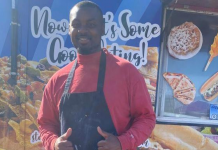
After 16 years of serving lunch from Stan’s Hot Doggie Dogs mobile stand, Stanley Painter’s work has acquired a steady rhythm.
Using tongs, he whips together a hot dog to the customer’s specifications, then reaches into his black apron to divvy out the change. He’s quick, he’s friendly, and he’s cheap.
Painter has managed to sell his hot dogs downtown and peacefully coexist with the nearby restaurants. “I’m not taking anything from them. It’s the other way around,” he said with a laugh in between hurried customers.
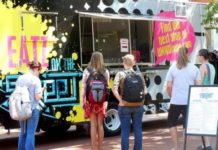
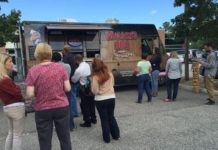
He’s one guy with a food cart, though, and he’s also the only street vendor you’re likely to find on any given day downtown. If the City Council decides to allow food trucks, which are larger, more sophisticated operations, then the options for a quick bite in downtown would increase.
That’s exactly what opponents fear: that the food trucks, with their lower overhead costs and cheaper prices, would have an unfair advantage over traditional restaurants. The growing enthusiasm for the mobile eateries in Norfolk has met the resistance of city officials who worry about the effect on restaurants.
“I recognize that there is a concern with our established restaurants about competition, but that has not been a deterrent in other cities that have done it successfully,” Councilwoman Theresa Whibley said at a recent council meeting, pressing the issue.
“A rising tide has floated all the boats.”
Food truck proponents argue that, with the right limitations, food trucks would add a healthy dose of liveliness to Norfolk’s downtown that would attract people and, as a result, improve business for all.
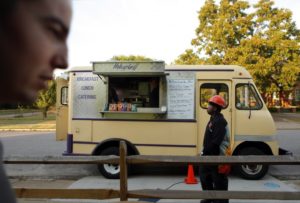
“The people who are predisposed to be anti-food-trucks immediately assume that you want to park a truck in front of (Granby Street restaurant) 456 Fish with two wheels on the sidewalk and on a loud microphone saying, ‘Eat here, not there,’ ” said Kevin Murphy, president of the Downtown Norfolk Civic League. “That is not at all the vision.”
Re:Vision Norfolk, a civic group that regularly weighs in on planning issues in the city, has submitted a formal request to amend the zoning ordinance for downtown to loosen restrictions on food trucks. The Planning Commission is scheduled to consider the issue at its Dec. 13 meeting. Drew Ungvarsky, representing Re:Vision, said the group has analyzed the approach used in cities that have a thriving food truck culture.
“We are far from the first people to figure this out,” Ungvarsky said. “This has been resolved a hundred times over in this country.”
Specifically, the request is for the city to broaden the hours of operation for mobile vendors and how long they’re allowed to serve at a single location within a 24-hour period. Currently, they are limited to one hour; the proposal would change it to three. Food trucks also could serve customers till 2 a.m. daily under the proposal.
The real controversy lies in where food trucks would be permitted to set up. Food truck supporters say they want the City Council to allow the diners-on-wheels to set up on both private and public property downtown, as long as they have the property owner’s permission. They would not be allowed in the public rights of way, such as on a sidewalk. Under this arrangement, a food truck could park at public areas like The Plot or around Scope.
Council members have mixed feelings about whether the food trucks should be on public property. Vice Mayor Anthony L. Burfoot said having food trucks on city property would be unfair to other downtown businesses.
“We’re very fragile downtown, despite what some folks might think,” Burfoot said.
“I don’t think we should stand in the way of that, but I don’t think we should be out on the front end.”
But Ungvarsky, who is opening a traditional restaurant at 429 Granby St., said food truck businesses aren’t asking for special treatment, noting that the businesses have to pay many of the same taxes as traditional restaurants. He said he thinks food truck owners would be willing to pay to park on city property, as long as the fee was in line with what the private market would charge.
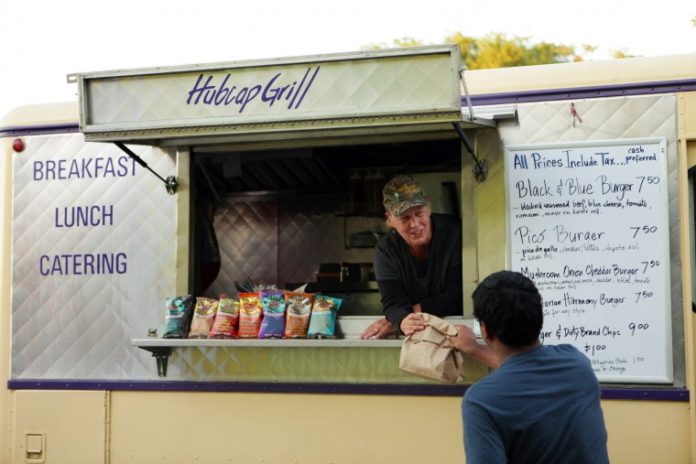
Evan Harrell, owner of Hubcap Grill Norfolk, which he started with his mom in February, acknowledged that his overhead costs are lower than a restaurant owner’s, but so are his sales. It’s all proportional, he said, and the food truck life isn’t as glamorous as some might think.
“I can’t sell alcohol. I have no seating. If it rains, I can’t go out,” Harrell said. “I’ve had to fix the truck when it broke down at 2 a.m. on the Hampton Roads Bridge-Tunnel.
“What gives me the advantage? The fact that I’m cool and trendy at the moment?”