
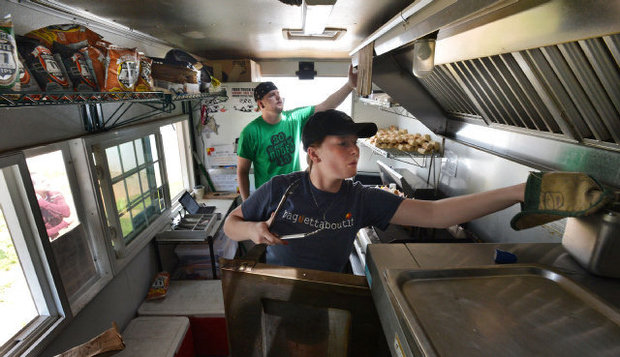
By Virginia Bridges | News Observer
Chuck Liddy — cliddy@newsobserver.com
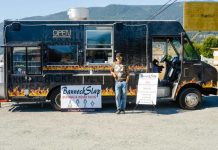
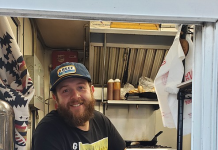
RALEIGH — When Mike Stenke rolled out his Klausie’s Pizza truck in Raleigh three years ago, people would ask him what he was doing, and then tell him to move.
Raleigh was slow to embrace this new class of mobile entrepreneurs, and many of Stenke’s competitors hid in the shadows, fearing they would be chased out of the city if someone complained.
Things have changed. Now Stenke is preparing his square pizza dough, grating cheese, and stocking up on toppings for a massive food truck rodeo to be held downtown Sunday, the first of four planned for this year.
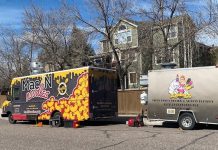
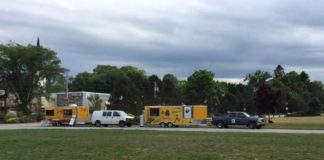
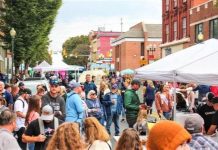
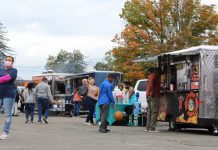
About 40 mobile food vendors and as many as 6,000 people are expected to attend the first Downtown Raleigh Food Truck Rodeo. The event, and the related expansion of the Triangle food truck scene, show how far the street vendor industry has come in the Triangle and nationwide.
Two years ago, when the Raleigh City Council considered whether to allow food trucks to operate routinely in the city, council members worried about food safety, the impact on brick-and mortar restaurants, and whether trucks would hog scarce parking spots. Council members also asked whether trucks would bring crowds, litter and noise.
But when the council revisited the policy a year later, it increased the numbers of food trucks allowed per lot, after no complaints had been lodged against the mobile vendors.
The process gave local trucks some legitimacy, Stenke said, and the city started to embrace the mobile vendors after business owners, event planners and nonprofit organizations learned that the trucks are an easy and affordable way to cater an event and increase visitor traffic.
“And people started to say, ‘Hey, wow, this is a great idea,’ ” Stenke said.
A growth sector
Across the U.S., the street vendor industry is a bright spot in the food service sector, growing at an average annual rate of 8.4 percent in the past five years when the weakened economy drove consumers to decrease overall spending on nonessentials such as dining out, according to an August 2012 report prepared by IBISWorld, an independent publisher of U.S. industry research.
In the Triangle, the mobile vendor phenomenon can be measured by the short history of food truck rodeos.
The first food truck rodeo was held on a Sunday in June 2010 in the parking lot at Sam’s Quick Shop in Durham.
It was organized by one of Durham’s food truck pioneers, Only Burger owner Brian Bottger, who coined the phrase “food truck rodeo” when he struggled to explain the event in less than 140 characters on Twitter. His then partner, Tom Ferguson (who now owns biscuit and doughnut shop Rise), said when a handful of boats fished together in Texas, they called it a rodeo.
“I said, ‘All right, let’s call it a food truck rodeo,’” Bottger said.
The event drew a large crowd, but the generators were noisy, the heat was brutal, the lines were long, and many of the trucks sold out of food within the first two hours.
“Nobody came prepared for the crowds that we had,” Bottger said.
Soon, the Durham rodeos moved to Durham Central Park, which includes bathrooms and a covered pavilion.
“Since then it has just gotten progressively bigger, more trucks, obviously, and bigger crowds each time,” Bottger said.
Pie Pushers co-owner Becky Jo Hacker volunteered to help Bottger plan the quarterly rodeos, which attracted more than 50 vendors in March. Organizers expanded by closing surroundings streets, and added silent generators, live music and local beer.
Hacker said that 75 trucks have requested to participate in the Father’s Day rodeo in June.
“It’s crazy to see how we can incorporate as many food trucks as we can fit safely in that space, but how it doesn’t actually take away from our individual sales,” Hacker said. “You might see a little up and down because of the weather and the turnout, but in the larger picture of it, because we have 10 more trucks doesn’t mean we do that much less.”
Meanwhile, food truck owners have spent the years perfecting their rodeo performance. Only Burger sold out early at the first couple of rodeos, but they developed a system to serve customers from beginning to end that involved installing a second fryer and restocking the truck faster.
Over the years, the Only Burger truck has doubled its output from 60 to 70 burger combos an hour to 120 to 130, Bottger said.
Bringing it to Raleigh
Guy Caprioli, president of Music on the Porch, which is organizing the Raleigh rodeos, said he hopes the downtown event will take food truck rodeos to a new level. Vendors will line one side of Fayetteville Street starting at the State Capitol, and tables and chairs will line both sides of the street, he said.
Food truck vendors pay $155 each to attend the event, which helps cover the infrastructure costs.
Initially the event was hoped to raise additional money by offering early VIP tickets, but that was scrapped and tickets refunded after social media and website traffic indicated that attendance could be well more than the 4,000 initially expected, Caprioli said.
Caprioli said he and others have worked hard to ensure easy traffic flow, and that there are enough bathrooms, hand-washing and handicap stations, trash and recycling areas, along with seating for 1,000 people and two silent generators for the trucks. Food truck “gurus” will be stationed at the information table to answer questions about menus and vendors with special menu needs.
Caprioli said he spent months scouting the best location for the event after people kept asking him about organizing a Raleigh rodeo.
“It seemed to be something that people were really passionate to make happen in Raleigh,” he said.