









 Joseff VanHorn is “just a little concerned” about the future of the state of Michigan’s tax credit incentives for movies filmed in Michigan.
“Is it staying? Or going?” he wonders.
Actually, VanHorn is probably more than a little concerned. His company, YoChef’s Catering, has only been in existence for about eight months, but in that time it has been contracted to provide catering and craft service on four movie sets in the Grand Rapids area, and he expects to start another one in late November or so.
There are strict and esoteric rules in the movie business, some of which pertain to the catering and craft service. Adhering to the rules and Hollywood traditions can make it challenging for business owners like VanHorn to make a profit on a movie set, but he said he has figured it out, and every movie he does, he learns a little more.
“I don’t have all the answers, but I was able to squeak out a meager profit on the last two movies that I did, and I took that money and re-invested it into my little company,” he said.
In October, he expanded his food service business venture and now employs about 14 people, plus more on a temporary basis for major events.
“None of this could have happened if I didn’t have money that I made from the movies, because I had to buy a walk-in cooler, I had to get a truck to deliver the food … and the banks weren’t giving any money away,” he said.
VanHorn, 42, is a Grand Rapids native who started working in hospitality at age 16, doing set-up for banquets at the old Hoffman House restaurant on 28th Street. After that he worked at such places as the 1913 Room, Spinnaker and Peninsular Club. In 1986, he went into the Marine Corps, and while serving in the Marine reserves in Southern California, he started working in restaurant management.
He has worked as general manager and/or executive chef at a number of places for at least the past 10 years, he said, including The BOB. When the JW Marriott opened, he was the food and beverage operations manager. More recently, he was general manager/executive chef at Celebration Banquets and Catering.
VanHorn also is one of the regularly featured chefs onWZZM 13′s “Take Five & Company,” where his culinary skills are put to the test each month.
As general manager/executive chef at Celebration Banquets, he organized and launched its catering service, and in August 2009, Celebration was selected to be the caterer and craft service on the set of “The Genesis Code.”
“You almost have to forget everything you learned as a caterer,” when working on a movie set, he said. For one thing, there’s the “craft service” business: the people who make sure there are always fresh drinks and snacks available on the set for the actors and crew. It seems as if they would be the same people as the caterers, right? Wrong.
“Hollywood looks at them as two totally different things,” said VanHorn, who innocently thought he could blend the two functions. He found he had to have four employees working as the caterers — cooking and serving the food — and three craft services employees to be on the set every minute the actors and crew are there.
“In the movie industry, they eat all the time — constant grazing,” said VanHorn.
The catering team shows up with the real meals at least twice each day. They are there at the start of shooting each morning with a meal “like a Sunday brunch, every day — but it has to be different,” said VanHorn. Six hours later, the caterer shows up again with “lunch.” It might be close to a normal lunch hour, but it’s not a typical lunch, said VanHorn. It’s usually beef, chicken, or fish entrees, a vegan entrée, salad bar and dessert. “Quite the spread,” he said.
Union rules require yet another full-course meal if the shooting is still going on 12.5 hours after it started.
But the industry standard only allows the caterer to charge about $16 per person for both breakfast and lunch, according to VanHorn.
“You have to figure out how to make a dollar out of that,” he said.
When a caterer works a wedding, for example, she or he knows exactly when and where to serve what food and how many people to plan for. On a movie production, however, “They don’t tell you what they want, but they’ll tell you a lot of things they don’t like,” said VanHorn. And the number of people to be served, the locations and times “change daily. You have to be flexible, like a traveling circus.”
But boring it isn’t. Obviously, caterers and craft services come in close contact with Hollywood celebrities. VanHorn said he met Ernest Borgnine on the set of “The Genesis Code.”
“Ernie — as he likes to be called — he’s just a working man,” said VanHorn. He eats with everyone else on the set, and he isn’t fussy, eating “whatever is out there.”
By the time he began working on the set of “Genesis Code,” VanHorn had a lot of experience launching and managing food service businesses “like they were my own,” he said, and he had the itch to start his own business. He and Celebration parted ways and he was seriously considering buying an existing business last winter when a friend, another chef in town, told him that St. James Parish in northwest Grand Rapids needed a caterer to put on its annual Lenten fish fry, one of the largest in Grand Rapids.
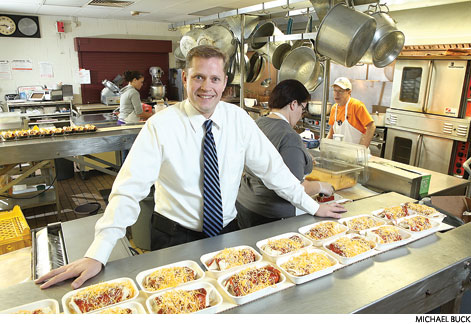
He took the job and used the big commercial kitchen at the St. James Family Center on northwest Bridge Street. The parish ended up leasing it to him for his own catering business; it was largely unused since the St. James elementary school closed a few years ago.
Starting his own business was “very scary. In fact, I didn’t have a pan to start with,” he jokes. “I just had my hopes and dreams.”
Since then, YoChef Catering has served two Curtis “50 Cent” Jackson films shot in Grand Rapids (“Caught in the Crossfire” and “Gun”), plus “30 Minutes or Less” and “Touchback.” The latter two were “the largest that I’ve ever done,” said VanHorn.
A catering firm that sells hot lunches at factories in the Grand Rapids area downsized a year ago, closing its kitchen and laying off staff. It began using a kitchen in the Detroit area to supply its food. VanHorn visited the company recently to talk about buying its used equipment and ended up with a contract as food producer, replacing the Detroit kitchen.
“I want to invest more in this business. I need to get a mobile kitchen, but that’s a $100,000 investment. If that movie incentive goes away, then that’s all I will have,” he said.
“I’m not putting all my eggs in one basket. I’m trying to diversify” in case the movie makers go away, he said.
He feels the movie incentives are one strategy that panned out “for a little guy.”
“I can’t get any smaller than I am right now,” he said. “And I don’t want to be a nonprofit, either,” he said with a laugh.
Pete Daily