








By David Reevely | Ottawa Citizen
Photograph by: Mike Carroccetto , Ottawa Citizen
OTTAWA — A key City Hall committee approved slightly looser rules for street-food vendors Thursday, hoping to get more Pad Thai and shawarma stands running by next spring. But the new regulations are so dead-set against sausages and fries that some councillors are complaining they amount to nanny-statism.
“I think our role is to determine how many vehicles there should be, where they should be, but then it should be up to the market, the individual business person what they’re going to sell,” said College Councillor Rick Chiarelli, the one member of council’s community and protective services committee to vote against the planned changes.
He didn’t like the city’s plan to subject vendors who want one of the 20 new spots on city streets to an expert panel that’s supposed to make sure the new offerings are interesting and make downtown more vibrant, rather than expanding the dominance of Pogos and poutine. The panel is to have members from the restaurant industry, the local-food movement and the city’s health department. It is not supposed to pore over calorie counts and carbohydrates, but it is supposed to approve menus generally.
“It is not our role to engineer menus,” Chiarelli said. Councillors Jan Harder and Eli El-Chantiry were also concerned that the city not push its way into areas where it has little expertise, and especially that it not insist vendors sell healthy food even if customers don’t want to buy it. The provincial government has forced school cafeterias to sell only healthy food, Harder said, and now legions of teenagers hustle out to junk-food restaurants at lunch every day.
Committee chair Mark Taylor argued that the point of the panel is to encourage creativity and make sure the best vendors get the new spaces — the additional 20 spots will make for a total of 64, still far less than the 100 spots downtown Ottawa had in 1994, before the city started smothering the street-food industry by refusing to issue new licences. There should be competition to get them, Taylor said, with the panel providing “a springboard” for would-be street chefs to give the effort their all.
Practically speaking, an effort to open the street-food scene does need to strike a delicate balance. Many restaurateurs don’t like street vendors because the vendors can undercut them, and pack up and go home when business is bad; a permanent restaurant is a lot more expensive to run. So the new rules say that vendors can’t set up within 46 metres (150 feet) of an existing “food premises,” which could be anything from a restaurant to a supermarket with a hot take-away counter. A restaurateur who sees a potential symbiotic relationship with a great vendor can waive that restriction, though.
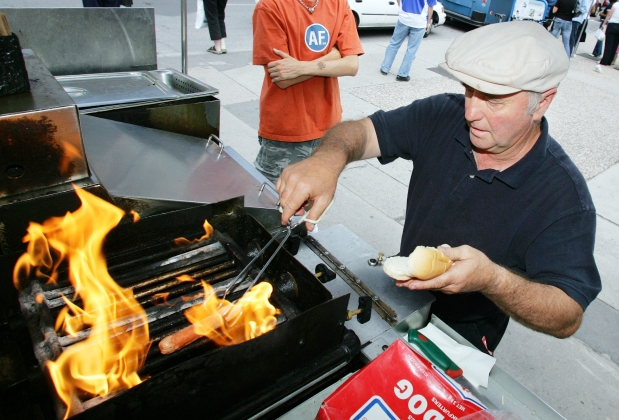
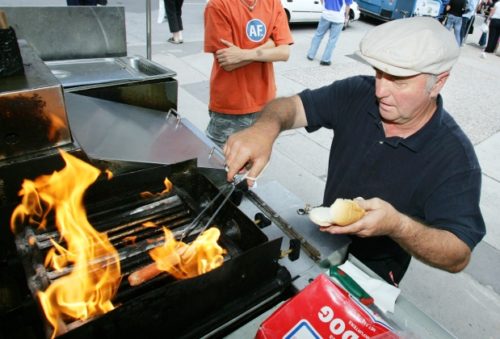
Terry Scanlon, whose hot-dog cart has been a fixture at Bank Street and Laurier Avenue for decades, said he supports the new regime. Keeping street vendors away from brick-and-mortar restaurants eases conflict, he said, and it’s all certainly better than the free-for-all that the city had in the early 1990s, when vendors didn’t have their own assigned spaces and showed up early each day to fight each other for the legal vending locations.
He concurred with Chiarelli about the menu panel, though: “I’m sure there’ll be demand from people who want (healthy high-end) food,” he said, but “it should be up to the person doing the vending. It’s our money, it’s our effort, it’s our time.”
Philip Powell, the city manager who’s worked on the new rules for years, said his department has learned from other cities’ attempts to liberalize their street-food rules. Toronto tried an extremely prescriptive system where the city even supplied new vendors’ carts to make sure they’d be up to standard, and it was a catastrophic failure; Portland, Ore., has an internationally famous street-food scene with very loose rules, but Powell said it turns out the vast majority of Portland’s food trucks are on private property, not city streets.
That’s where most of Ottawa’s existing street-food innovators work, as well, particularly on the summer festival circuit, and Powell wants the city to find ways to make their lives easier. The menu panel, for instance, would only weigh in on vendors setting up on the city’s new reserved street locations.
Restaurateur Eduardo Bailetti told the councillors he’s interested in joining the food-truck scene but he’s worried that the timelines are too tight to get a genuinely creative new business launched by next May. Powell acknowledged that challenge but said he’s confident it will be doable.
With a 6-1 committee vote in favour of the new rules, they head to city council for a final vote next Wednesday.