





By Dave Johnson | St. Catherines Standard
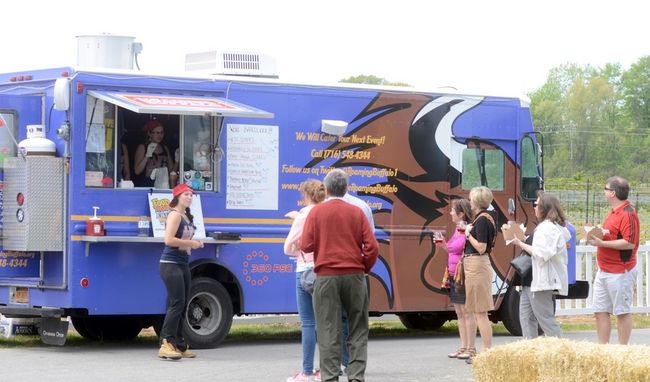
NIAGARA-ON-THE-LAKE – Everyone in Erie County wants a piece of the pie — or in The Roaming Buffalo’s case, a bite of the burger — when it comes to making money off food trucks.
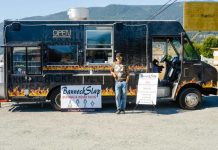
Chris Taylor, owner of The Roaming Buffalo, recently brought his truck to the Food Truck Eats festival at Peller Estates Winery in Niagara-on-the-Lakes and spoke about the issues surrounding food trucks in Buffalo and surrounding suburbs.
“The City of Buffalo has calmed down a lot and allows us to set up in a lot more locations and have lowered fees for everything. We’re doing a lot better in the city,” said Taylor, who has operated his food truck for nearly two years. July 3 will mark his second anniversary.
Now that Buffalo has changed its attitude toward food trucks, he said the suburbs all want a piece of the pie and licence fees to set up in places including Amherst and Williamsville are all over the place.
“They all want to charge us different fees to come in, which we’re strongly against.”
One licence, whether statewide or countywide, would make sense, to allow food trucks to operate anywhere he said.
Amherst for example, said Taylor, has outdated laws when it comes to food trucks.
“They charge us $100 for a permit that lasts 90 days for one location. If you wanted to set up at five different locations, you’d be paying $500 every 90 days.”
The city was proposing an annual fee of $400, with operating hours from 11 a.m. to 8 p.m., 100 feet away from restaurants, staying away from residential areas.
“That meant if you were in a commercial area next to a residential area, you couldn’t be there. … It’s pretty restrictive.”
In Buffalo, Taylor pays $800 a year to operate and his truck is inspected by the city’s health department. He also has a business licence issued by the State of New York.
He’s not against paying a fee to operate in different cities, but said the fees should be set to cover the costs of issuing permits, which would be somewhere in the area of $25 to $30 in most cases.
Taylor said restaurants in various towns and cities always claim food trucks have an unfair advantage when it comes to operating and selling food, such as not having as much overhead.
“We pay taxes like everyone else, an $80,000 food truck is not cheap. We don’t make the profits they do and our profit margin is so much smaller than a restaurant. We don’t have seats, bathrooms, heating, air conditioning and don’t serve alcohol. I want to see all these advantages we have over a restaurant.”
Taylor said if he makes a reservation at a restaurant and happens to pass a food truck nearby, he’s still going to go where he made reservations to eat.
If food trucks are near restaurants and happen to be very busy, Taylor said people may not want to wait in line and may migrate to the restaurant.
“We can create business in an area.”
Sid Friedman, a co-founder of Ontario Food Trucks Association, said the argument that food trucks hurt business is unfounded.
“I don’t know where they come up with something like that,” he said in relation to a food truck fight in Niagara-on-the-Lake.
With the recent Food Truck Eats festival, he said it shows how wineries, with great restaurants, aren’t afraid to bring in food trucks.
“It’s a win-win. It shows how you can bring in something new and not hurt a business, but actually help it.”
Peller Estates, he said, had to bring in extra bartenders to deal with the crush of people that came from all over the Niagara region and beyond.
Those people, said Friedman, were leaving with wine, sometimes cases of wine, from Peller’s retail shop. Wines they can’t get at the LCBO.
While the winery benefited from the event, Friedman said so too did Niagara-on-the-Lake and beyond.
“We rented a place in town to stay and went shopping. Eight of us went to the Regal Diner (in Niagara Falls). Friends of ours stayed down here, too.”
Friedman said before people attended Food Truck Eats, they went on wine tours and many ate out at area restaurants later.
“The argument that food trucks hurt business is unfounded. I don’t know where the come up with something like that,” he said.
Suresh Doss, publisher of Spotlight Toronto, co-founder of Ontario Food Truck Association and Food Truck Eats founder, also touched on the subject of food trucks in relation to the food fight in Niagara-on-the-Lake.
An ad was taken out recently, with restaurants in the ‘Old Town’ opposed to the trucks.
“None of the food trucks want to be in town, they never said they wanted to be there. I don’t understand where the animosity comes from. We just pumped 7,000 people into wine country … it was hard to find a hotel room or B&B.”
Doss said all one had to do was check social media and see that many of those people were earring locally, tweeting out photos of their meals from local restaurants.
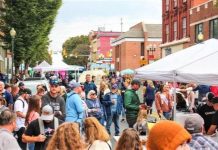
And not only were there were more people in Niagara-on-the-Lake, but they were coming from outside of Niagara, from places like Buffalo, Toronto, Cleveland, Pittsburgh, Montreal and even Iowa.
“I met a bachelorette party from Pittsburgh … and the people from Iowa freaked me out. Chicago is closer for them,” Doss said, adding that city has a food truck scene.
The food truck industry and culture as a whole is the hottest trend in the world right now.
“The way I see it, any industry has to adapt and evolve … there’s no vision with the restaurants in the town in Niagara-on-the-Lake.”
He said wineries like Hillebrand, Ravine, and Peller, which have great restaurants, have embraced food trucks and aren’t afraid to bring them in.
http://www.stcatharinesstandard.ca/2013/06/03/food-trucks-everyone-wants-a-bite