
By James Simpson and Peter Fournier

Those looking for a quick fix to their hunger now have many more choices than they did in the past.
In an economy where most restaurants aren’t rushing to publish their yearly profits, a successful business model may be right in front of people.
Maybe even at a stoplight.
The idea of mobile food trucks isn’t new, but has freshened up in recent years into a unique and competitive market, thanks to an economy aiming to save and the expansion of social media to market business.
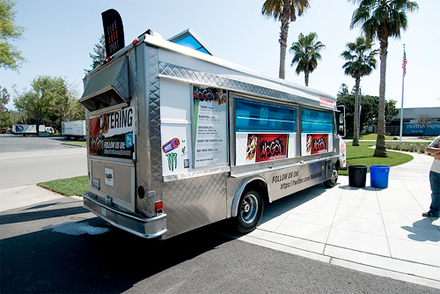
Bay Area consumers can now enjoy more than a Saran-wrapped turkey sandwich and a bag of Doritos, and depending on their taste, can find an Indian, Chinese or Italian food truck that’s anything but generic.
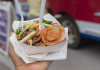
Those looking to diversify their choices might be surprised to see trucks serving Korean BBQ like Mogo’s BBQ in Santa Clara, The Louisiana Territory featuring Cajun food in the heart of Mountain View, and curry in San Francisco at twice the speed and half the price of a restaurant.
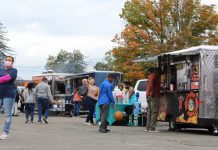
Already popular in cities like New York and Los Angeles, food trucks are convenience coupled with mobility and have slowly started their migration into the South Bay.
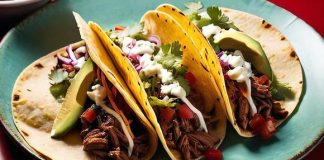
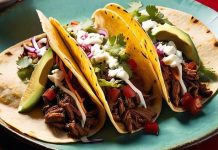
Alejandro Montes, owner of El Taco de Oro, a restaurant grown from the success of his food trucks of the same name, is known for delicious yet inexpensive tacos.
Montes, 54, first started his truck on a small lot in Alviso, and was so successful he never had to leave.
“I started my restaurant (in Alviso also) because this is where I got my following,” he said. “But my trucks are what people know, and most times the truck is busier than my restaurant.”
Relying on customer referrals, Montes leaves one of his food trucks parked outside his restaurant and has others serving areas in Santa Clara, Sunnyvale, and Redwood City.
While the foods in the trucks have evolved, so have the owners. Unlike Montes, some trucks aren’t relying on the ability of being mobile and word-of-mouth referrals.
Today, new trucks are teaming up with other trucks and using social networking sites to help grow their business.
Matt Cohen owns and operates Off the Grid, described as a “mobile catering consultancy” on its website. Cohen helps those wishing to test the food truck market model in the Bay Area get off their feet.
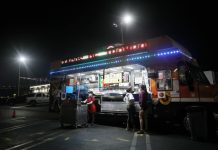
Founded in 2008, the company rents out trucks, which are run by local business at five or six San Francisco-area markets that can have anywhere from three to 10 trucks there at one time.
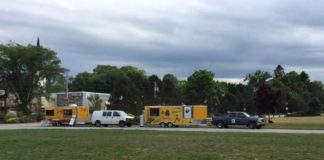
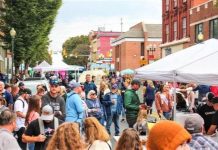
The markets/trucks are usually located at street corners or major plazas, while others like their Fort Mason Center – a seasonal market running every Friday from Mid-March to early November — brings around 30 trucks into one place and gives hopeful entrepreneurs a shot to test their product for a night.
If there is a food truck pioneer in the Bay Area, Cohen would be it.
“I was inspired by Asian street food and I wanted to recreate that experience,” he said. “And I had experience (with food) from the hotel industry, so it was a logical decision for me.”
Cohen currently has his sights set on expanding to two markets in the East Bay, and at least one in the South Bay by this summer.
If Cohen’s clients have a Twitter account for their business, their tweets and current locations are grouped together in one big feed on his websites street food finder tab. Cohen knows sites like Twitter have Facebook have made his business and food trucks appeal what it is today.
“We couldn’t do what we do without social media. It’s our main connection to our customers, and it gives our customers immediate updates,” he said. “And it’s our main method of communication for those who want to know more about Off the Grid.”
Marjorie Freedman, an assistant professor of nutrition at San Jose State University, is an expert of fad diets and nutrition education. She thinks the use of social media and creativity exhibited by the operators of the trucks adds to the intrigue of the consumer who may have written off food trucks and their previous stereotypes.
“Food trucks don’t want to show up and not let anyone know about it. In the old days, when a truck went to the same location every time, quite frankly, they didn’t have to go anywhere else because people knew where the trucks were,” she said.
At the same time Freedman said there’s an entirely different crowd following in the new age of food trucks.
“Clearly the people trucks want to reach are signed up to their Twitter accounts,” she said. “I think it appeals to a certain demographic that is interested in that and maybe these are the same people that are looking for diversity in their diet.”
Still, Freedman said the success and interest of food trucks in this economy ultimately comes down to a very simple concept: Saving money.
“Having a mobile food truck is a lot less expensive,” she said. “You may not be able to prepare the same types of foods and obviously you don’t have a place to sit down. If they can do it this way, it’s a lot less overhead and a lot less capital.”
http://www.spartandaily.com/class-reports/food-trucks-cooking-up-a-recipe-for-success-1.2074046