





By Chip Smedley | LancasterOnline.com
A fan of Sala Thai restaurant, 335 N. Queen St., made a First Friday pre-emptive strike.
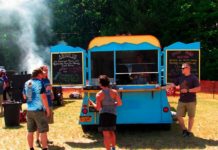
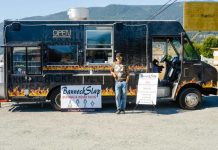
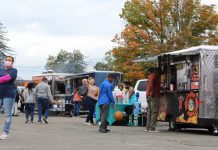
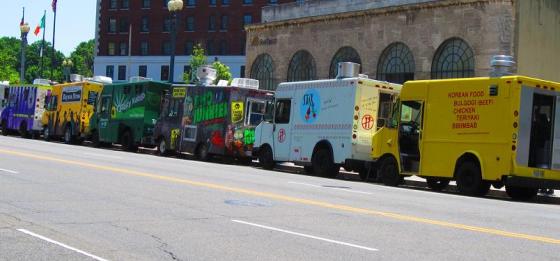
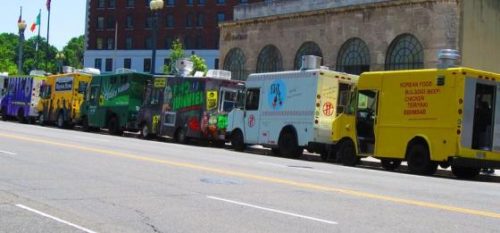
On First Friday in October, he said, a roving food truck parked in metered spaces in front of the restaurant and began serving food. He thought this was bad form, particularly because the restaurant pays property taxes and represents an investment in downtown Lancaster.
He wondered if the city condoned this type of operation.
It does not, said Randy Patterson, city director of economic development and neighborhood revitalization.
In an email, Patterson explained, “Current city ordinances do not permit food trucks to park and operate in any public space, which includes parks, sidewalks or streets, within the CB and CB1 Districts of the city unless permitted to do so by the city.”
The CB (central business) and CB1 districts encompass the downtown commercial areas, and permits may be issued for only four locations — two at Penn Square (one for the Fulton Bank quadrant and one for the Citizens Bank quadrant) and two at Lancaster Square, on the east side of Queen Street.
Patterson said the Urban Olive food truck, which parks at Lancaster Square, has paid for a permit at that spot.
Other than the four previously named locations, Patterson wrote, “There are no other permitted locations within the CB and CB1 Districts. I would also emphasize that having a health license to operate a food truck is not the same as having a permit to operate in one of these locations.”
Patterson noted that food trucks are not allowed to park in metered spaces to operate even if they plug the meters.
Patterson added, “Food trucks may make arrangements with private property owners within the CB and CB1 Districts to operate their food trucks, as long as they have a current health license. An example of such a location is the surface parking lot at North Queen and Chestnut streets. A food truck operator could arrange to set up on the parking lot if the owner permitted them to do so.”
Rocky roads
Readers contacted The Watchdog about rough roads resulting from sewer line installation projects at Long Farm Lane and Kissel Hill Road.
Residents who travel Long Farm Lane just north of Valley Road encounter a 15-foot-long trench down the middle of the roadway, as well as a number of lateral trenches. Though the trenches were topped with asphalt, cars driving over them have depressed the material, making for a bumpy ride.
Scot Fertich, engineering director for Lancaster Area Sewer Authority, said installation work in that area is not yet complete, so only temporary patches have been placed on the trenches. The final paving will take place next spring.
However, residents wanting to connect to the sewer line may do so before then. Fertich said LASA plans to send letters to residents within the next few weeks to provide information about connecting to the line.
Meanwhile, Fertich urged wanting to report roadway problems to contact him directly at 299-4843, ext. 5830.
He said LASA would dispatch a contractor to the site and fix the problems.
Kissel Hill Road, on the other hand, has the opposite problem. Work there is producing elevated bumps on the roadway.
Fertich said the work there is not yet complete. “We hit a lot of rock,” he explained. “We’ve done some blasting, but as a result, the rock heaved,” causing the bumps. The contractor, he said, has been shaving the bumps to try to keep the roadway as level as possible.
Fertich said the situation is a difficult one, adding, “We’re doing our best.”
Sidewalk follow-up
One question and one clarification arose from last week’s segment on the city issuing notices to property owners to inform them they had to repair broken sidewalks in front of their homes.
One emailer wondered if the city ever repaired broken sidewalks itself and then placed a lien against the property for the work (as the city does when it is forced to clean up trash or cut down weeds on untended properties and is not reimbursed for the work).
Charlotte Katzenmoyer, city public works director, said at one time the city fixed sidewalks on properties where the owners did not comply with notices.
But, she said, “We spent a lot of money and often never recouped the money, because we cannot enforce a lien until the home sells, so the lien can sit there for decades.”
No interest accrues on the lien, and worse, Katzenmoyer said, “If the home goes into foreclosure, we often get nothing, so it really isn’t fair that the rest of the taxpayers subsidize this work and often we have to write off the debt.”
She added that if the city performs the work, it must contract the job out. The bottom line: “Property owners can get it done much more cost-effectively,” she said.
As for the clarification, a resident called to point out that sidewalk repair work was being done in the neighborhood of South Pearl and Hager streets, not Pearl and Hager streets.
There is a South Pearl Street and a Pearl Street in the city, but no North Pearl Street.
This has caused confusion with mail delivery, Katzenmoyer said. So too, noted the caller, for 911 responders.
Katzenmoyer said the city has discussed rectifying the situation but needs to get all of the property owners on board with any potential change.
http://lancasteronline.com/article/local/770377_Food-trucks-need-permits-in-Lancaster-city.html