
By Karen Miltner | Democrat & Chronicle

When Jessica Toner was a kid, she loved the shaved ices and slushies she got at fairs and festivals.
Now, as a young mother of twin toddlers, the city resident wanted to share that cool joy with her girls, but without the high-fructose corn syrup, artificial colors and other ingredients that she consumed by default years ago.
So Toner, a devoted locavore, bought a shaved ice maker, began making simple syrups with fresh fruit and vegetable juices and purees from local farms and her backyard garden. For sweetening, she used sugar, honey and other natural sweeteners.
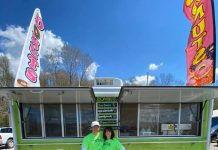
Wanting to share the cool treats with other like-minded families, she and her husband, Mike, purchased and refurbished a 1964 Shasta
Trailer. Snow Daze, as their mobile shaved ice business is called, is now drawing lines at the Sunday Brighton Farmers Market and the Thursday evening South Wedge Farmers Market.
Flavors include orange pineapple, peach oolong (made with seconds from a local fruit farmer), tart cherry and Concord grape (also locally sourced).
“It’s definitely not your average snow cone,” says Chad Oliveiri, a first-time Snow Daze customer at the South Wedge Farmers Market. “These things taste as good as they look.”
Touting a flowery apron, vintage 1950s and ’60s kitchenalia and a sweet gee-gosh demeanor, Toner could be Rochester’s June Cleaver of the 21st-century food truck movement.
“The idea of food trucks intrigues me. I want to inspire other small-food entrepreneurs to do the same,” says Toner, who also runs Artistic Eats, a food distribution business, with her husband.
Toner has been studying the food truck movement in other cities, and she believes it’s Rochester’s turn to get rolling. She joins a growing and creative convoy of mobile food vendors who are scanning Craigslist for old delivery trucks or vans, outfitting them with miniature kitchens, then coming up with original recipes.
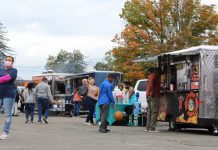
All that’s left is to navigate to festivals, farmers markets, fairs, nightclub districts after hours and wherever else they can find street-food fans willing to line up and eat without a table.
Larger metros have been vrooming with motorized street foods for several years. The National Restaurant Association reports that Los Angeles County has at least 4,000. Minneapolis approved a food truck ordinance this year, and Portland, Ore., has created a designated park for food trucks.
New York City has a form just to get on the waiting list for a mobile food unit permit, and crackdowns on the rising number of illegally parked trucks are becoming more common as their numbers multiply. Pressure from Buffalo’s brick-and-mortar restaurants recently led Common Council to delay approval of the city’s first roaming food truck law.
According to a new guide book titled Food Trucks, by Chicago food writer Heather Shouse, two social forces are responsible for putting street food on wheels. The first is the recession, which has made low overhead appealing to entrepreneurs and cheap meals attractive to consumers. Second, social media has melded an immediate bond between truck and customer, as Tweets and Facebook postings keep hungry customers informed about daily menus, locations and upcoming events.
Food trucks have gained visibility and respectability in other venues as well. Last year, the Food Network launched a reality show about the trend called The Great Food Truck Race. And this year’s National Restaurant Association’s annual convention included several sessions on the emerging mobile food niche.
Toner would like to organize a western New York food truck bazaar, where foodies could enjoy a moveable feast.
It’s difficult to know exactly how many food trucks are operating in our area right now. The Monroe County Health Department has about 175 mobile food units on the books. The majority are sidewalk pushcarts, says spokesman John Ricci, noting that their records do not differentiate between sidewalk carts and food trucks.
As a food production facility, food trucks and trailers in Rochester must follow the same local, state and federal regulations that other food businesses do.
While the early wave of food truckers were known for roving appearances at different locations and Tweeting their whereabouts to eager customers, Rochester’s fleet is more inclined to go to a single designated location or event and sell from there. In downtown Rochester, an annual lottery determines the spot, and once it is secured, you cannot go elsewhere unless you get a new permit, says Rochester city clerk Dan Karin.
The city has been approached by potential new vendors regarding different selling locations.
“The key issue is, can we find a spot for them that won’t cause a traffic problem,” says Karin. He urges people interested in truck vending to check with their municipality before investing in a vehicle.
When food trucks cross into another municipality, they have to get approvals from the individual town, says Jill Stolt. Her company, Yum Runners, hopes to spawn a fleet of food trucks in western New York. Her company also helps potential independent food truckers navigate the nascent street-food renaissance and regulations.
“Each town is different in permit cost (her research shows a range of $100 to $700), timeframe to get the permit (one week to two months) and cooperation level. If I were to generalize, most towns do not want the trucks on the streets, as they are worried about the dangers of obstructing traffic flow,” Stolt wrote in a Q&A last winter.
Vendors who ask for guidance from municipalities don’t always get the answers they want to hear. While Bill Klingensmith, who hauls his cart of pre-brewed Bona Fide Coffee each Wednesday by bicycle to the Foodlink Farmers Market, finds it easy to get into farmers markets and festivals, he is less hopeful about true street vending.
“If I buy a (solicitor’s) permit and want to change location, I have to buy another permit. The city says one permit per location. Then they came back and said that I can write in and officially change the location of my permit, but that takes time. … It’s a bit of organizational bureaucracy.”
Last year, Yum Runners put The Gourmet Waffler truck out on the road as a prototype. Painted bright yellow and orange with a Tin Man mascot with a waffle face and a spoon and fork for hands, The Gourmet Waffler truck sold Belgian waffles and fruity toppings at the Rochester Public Market, Fall into Canandaigua Festival, the Capt. Redbeard’s Pirate and Seafood Festival on Honeoye Lake, the Naples Grape Festival and other venues and events.
“The visual on the truck is very important. The wow factor of the graphics goes a long way in attracting your market,” says Stolt.
Stolt says The Gourmet Waffler is scheduled for several upcoming events, such as the new Greentopia Festival in September. Her business plan is to have at least nine Yum Runners trucks selling a variety of gourmet, all-natural foods by 2012.
Those who have gotten into food trucking the past couple years have done so for various reasons.
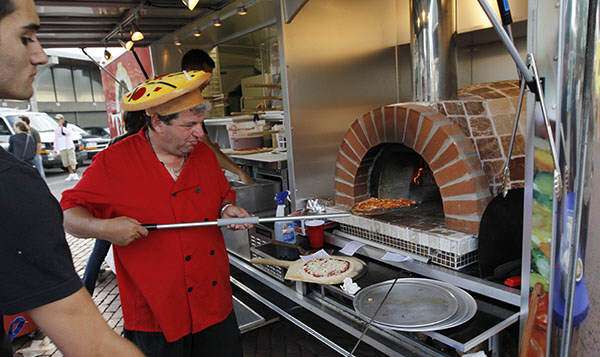
Builder Tony Simone started his Tuscan Wood Fired Pizza Catering operation last year as a way to market the customized brick ovens he likes to make and sell. Showing up at the Xerox Rochester International Jazz Festival, the Finger Lakes Wine Festival and soon to hit the NASCAR circuit with his 900-degree oven, Simone, aka Tony Tomatoes, finds he “is getting more calls for his (pizza oven making) business doing the (food) festivals” than other home and garden or builders’ trade shows he has done in the past.
For Casper DeMauro, owner of Casper’s Street Dogs Grill & Catering, making burgers, hots and Garbage Plates from a 1969 Chevrolet P30 van is the ultimate in food service freedom.
“It’s too hard to wait for someone to show up at a restaurant. If I don’t like my neighbors, I just move,” he says. The truck can often be found at Durand-Eastman Park beach. As Simone and DeMauro can attest, food trucks are an ideal catering venue for corporate events and private parties. Though Toner did not include catering in her initial business plan, she now wants to market herself to weddings and graduation parties.
Rick Ramos of Lynez’s Frozen Delights, which sells at various locations, including The Father’s House church in Chili, hopes that his food truck, which specializes in Spanish and Italian ices, will evolve into a restaurant.
Brenda and Junius Tyler of Dooster’s BBQ & Catering went from a backyard Weber grill to a traveling smoker and tent setup to a truck that pulls the smoker.
They tried parking at the intersection of Mt. Read Boulevard and Buffalo Road but found it took too long to sell out their foods. Events, catering and festivals are more lucrative.
For Valerie Elston, her boyfriend Seamus Clapp and his sister Elizabeth Clapp, a food truck was the most affordable and efficient way for them to realize their dream of serving poutine — Canada’s artery-clogging trilogy of french fries, gravy and cheese curds — to the masses. Now a mainstay at the Rochester Public Market, the Le Petit Poutine truck was launched with an investment of less than $10,000. With a brisk schedule of festivals, Elston predicts that by fall the business will turn a profit.
Their examples are inspiring other street food vendors and restaurants to follow suit.
Helen Serafine of Flippin’ Birds, a vendor of grilled Cornish game hens with dirty rice at Bands on the Bricks, says finding a truck is essential to the future of her business.
When vending at events without one, she says, “the setup and breakdown are too hard. We absolutely have to get a truck.”