
By Carolyn Shapiro | The Virginian-Pilot

Soon after Mark Clarke flipped open the back of his truck and served his first burger in a Virginia Beach strip mall parking lot in January, he began looking for a place in Norfolk to do the same.
After all, Clarke runs a mobile food business. Good 2 Go Burger can go anywhere. Or so he thought.
A graduate student at Norfolk State University, Clarke knows that eating options near campus are limited when cafeterias close. He talked to administrators at a church on Park Avenue, just outside the school grounds, to see whether they’d let him set up in their parking lot.
Norfolk, however, wouldn’t allow that. The city’s zoning rules limit food trucks to certain commercial and industrial areas, and the church isn’t in one.
For a budding group of food-truck operators, the challenges go beyond the usual startup requirements. Like any owner, they have to procure proper licenses and permits. On top of that, a mobile eatery must navigate a maze of complicated zoning and operational rules that differ from city to city.
“It was frustrating,” Clarke said, recalling resistance he encountered in Norfolk. “Here we are talking about small businesses as the engines of economic growth. There just seems to be a million hurdles and obstacles.”
Operators like Clarke distinguish themselves from the old-fashioned hot dog cart or fried-onion festival vendor. They are grilling fresh meats, embellishing sandwiches with pickled ginger and selling elaborate cupcakes named The Boss Man and Grammies Apple Pie.
They seek a foothold – albeit on wheels – in the local culinary culture. They want the freedom to set up shop wherever they can find a cluster of interested customers.
“The challenges are not just in Hampton Roads,” said Ilyse Rothman, who lives in Virginia Beach and founded Let’s Eat On The Go, a consulting firm for mobile food operations. Other cities with more established street-food industries – such as New York and Washington – also struggle to strike a balance between allowing on-wheels eateries to operate and protecting the public and other businesses, she said.
Hampton Roads cities now have an opportunity to address concerns about their rules while momentum for local food trucks is just revving up, Rothman and the mobile eateries’ owners said.
“I don’t think it’s a trend. I think it’s here to stay,” Rothman said. “It’s a new way of presenting food service to the public.”
The newer mobile restaurateurs in Hampton Roads said Norfolk has some of the strictest rules, mostly because the city prohibits them from working in the downtown business district.
Evan Harrell envisioned Main and Bute streets in downtown Norfolk as ideal locations for his truck, Hubcap Grill, serving breakfast and lunch. He also talked with the owner of a now-shuttered BP gas station in the Ghent area, at Colley and Westover avenues, about operating there.
Under city rules, he wasn’t welcome in either location.
The Ghent area is off-limits because it has a neighborhood overlay that restricts street vendors.
“That’s when I realized that I was up against something that I never thought existed,” he said. “It’s this antiquated way that Norfolk deals with business.”
Officials from Harbor’s Edge, the luxury retirement complex in a former industrial area on the city’s waterfront, asked Rothman to find them a food truck to provide an eating option for its staff and fill a restaurant void there. She learned that the downtown district extends to Harbor’s Edge, preventing a mobile operator from serving there.
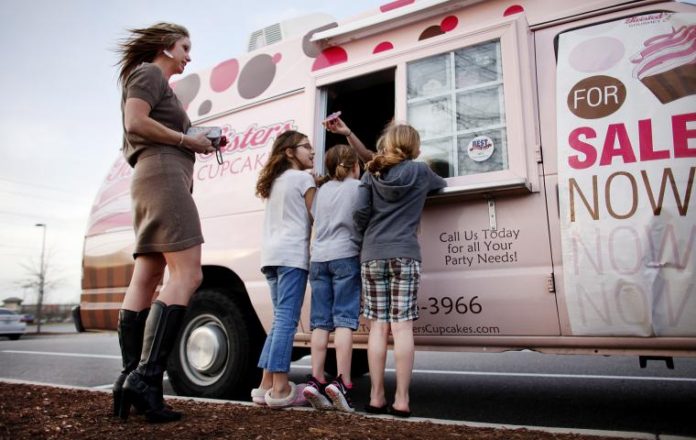
Downtown workers have begged for the Twisted Sisters Cupcakes truck to come to their offices, said Cassandra Ayala, who owns the Virginia Beach-based mobile bake shop with her sister, Tracy Busching. Ayala has had to explain the rules to those would-be customers.
If someone downtown places a cupcake order, Twisted Sisters can drive there and deliver the treats but cannot stay and cannot serve walk-up customers. That has created frustration for potential patrons who see the pink truck with the polka-dot roof and want to buy a treat.
Twisted Sisters does sometimes stop outside the Dominion Enterprises building at Granby Street and City Hall Avenue. Ayala said she doesn’t know whether that spot is within the downtown district.
“The line is unclear,” she said. “I’ve asked three different people to clarify that line for me, and I cannot get a straight answer.”
Norfolk wrote its regulations for food trucks in the late 1990s, as construction of MacArthur Center was under way and officials expected the downtown mall to spur retail and restaurant development nearby. Three previously existing hot dog cart operators were grandfathered under the new rules and allowed to stay downtown.
“There used to be no regulations for vendors,” said Susan Pollock, the city’s principal planner.
Mobile restaurants can park only on private property in a commercial or industrial zone and must have permission from the property owner, Pollock said. And they have a time limit.
“The idea is that you’re there for an hour and then you move on,” she said.
Norfolk is reworking its food-truck rules for downtown, considering ways to allow street service. The Downtown Norfolk Council has formed a subcommittee to get feedback from restaurant owners, some of whom oppose the mobile competition, Pollock said.
Meanwhile, Hubcap Grill has permission from the owner of a small, empty business at 51st Street and Colley Avenue to park in the lot there. The business is on hiatus until next month while his truck is repaired.
“I’m not discouraged,” Harrell said. “I like a good challenge, and I’m going to see it through.”
Not every South Hampton Roads city has a restrictive approach to food trucks, said Rothman, who has researched the local rules to help clients steer through them.
“If you look at Chesapeake and Portsmouth, they’re amazing,” she said. “They’re wide open.”
Each city code has provisions that apply to food trucks, but some fit the individual operator’s concept more loosely than others.
Twisted Sisters, for example, is considered an ice cream vendor under the Virginia Beach rules. Such “mobile peddlers” must stay on public streets where the speed limit is 25 mph or less and move at least one block away every 15 minutes.
That makes it difficult to build a customer base, Ayala said. Customers get angry if they come out to buy a cupcake and the truck has left.
She also has had to soothe upset Virginia Beach city employees, because Twisted Sisters cannot park on municipal property, Ayala said. The Oceanfront also is a restricted area. “Stationary peddlers” who want to park and sell their goods must stay on private property, get the location approved by the city and obtain written permission from the property owner.
“It keeps me from taking care of all the customers who want me to come,” she said. “It limits the potential of Virginia Beach to go any further in the food revolution.”
The opposite is true in Chesapeake, where the mayor has bought cupcakes just outside of city offices, Ayala said. “I go right up to the courthouse,” she said. “I go right up to the libraries.”
And in Suffolk, the two business districts within and near the downtown area are the only locations where a “sidewalk vendor” is allowed to stand and serve, said Scott Mills, the city’s director of planning and community development. The owner has to get a temporary use permit, good for 90 days, and operate during permissible hours.
In other areas of the city, a food truck would qualify as a “peddler,” like an ice cream vendor. “And you have to keep moving,” Mills said.
Even in a friendly city, it’s hard to avoid pitfalls, Ayala said. A Chesapeake Regional Medical Center worker called Twisted Sisters last year and said it had permission to sell cupcakes near a back loading dock. Ayala made stops there over several months and tallied 30 or more sales each time – until a security guard told her she had no approval to work there and had to leave.
“There’s no way to not feel like a naughty child,” Ayala said.
Her sister added, “We want to follow the rules, and we really want to go where we’re wanted.”
Twisted Sisters has found refuge in the parking lots of Kohl’s department stores. Each week, according to the mobile cupcakery’s online schedule, the truck rotates among the Kohl’s locations in Suffolk, Chesapeake and the Landstown Commons area in Virginia Beach.
Good 2 Go Burger has a standing gig in the parking lots outside Bayside Bar & Grill and Cabo Café, across from each other on Shore Drive in Virginia Beach. starting around 11 p.m., after those restaurant’s kitchens close.
As of today, Clarke planned for Good 2 Go Burger to serve breakfast and lunch at Half Moon, a shop at 16th Street and Pacific Avenue near the Oceanfront.
He and his wife, Shamola, also are getting permits and licenses for a second food truck, Marcia’s Caribbean BBQ, featuring the cooking of his Jamaican mother-in-law. They hope to start operating that truck in Virginia Beach at the end of this month.
And they’d like to expand both ventures to other cities, continuing to build diners’ interest in eating from trucks.
“Beginnings are always a little messy,” Clarke said. “The model is very successful in other cities, and there’s no reason it can’t be successful here.”
http://hamptonroads.com/2012/03/mobile-food-firms-face-hurdles-hampton-roads