








By LiquidMail | BubbleNews.com
Fish balls are a common food in southern China and overseas Chinese communities made from surimi ,漿(魚 yújiāng). They are also common in Scandinavia, where they are usually made from cod or haddock. Terminology 蛋The term 魚 (literally “fish eggs”) is used at street hawker stalls and dai pai dong 丸in Hong Kong, while 魚 圆(yú wán) and 鱼 (yú yuán) are more commonly used in Singapore and
Malaysia. Jump↑ back a section Production Fish balls made in Scandinavia are similar to meatballs, only with fish flesh instead of pork or beef. Meatballs made in Asia differ significantly in texture from their European counterparts. Instead of grinding and forming meats,
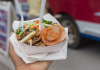
meat used for making meatballs is pounded, which lends a smooth texture to the meatballs. This is also often the case for fillings in steamed dishes. Pounding, unlike grinding, uncoils and stretches previously wound and tangled protein strands in meat. Jump↑ back a section Regional variations Steamed rice rolls with fish balls Fish balls and kwek kwek (hard- boiled quail eggs fried in batter) in the Philippines Fish balls with vermicelli sold in Bukit Batok, Singapore Swedish fiskbullar, here served with dill sauce and pasta Kaeng khiao wan luk chin pla: Green curry with fish balls Faroe Islands In Faroe Islands, fish balls are called knettir and made with ground fish and fat. Fuzhou In the Fuzhou area, “Fuzhou fish )丸鱼州ball” (福 is made from fish and has minced pork filling within the fishball.
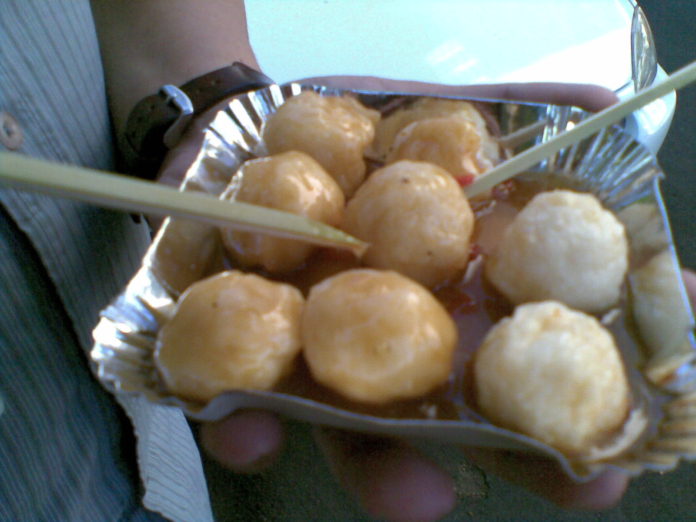
Hong Kong Yellow Fish Ball (Street Food) There are two kinds of fish balls in Hong Kong. One is smaller in size, yellow in colour, made with cheaper meat, and is sold on a bamboo skewer with five to seven fish balls. These fish balls are usually sold at food stalls. Many stalls support themselves just by selling this kind of fish ball, similar to hot dog stands in the United States. The fish balls are usually boiled in a spicy curry sauce. It is one of the most popular and )食熟頭representative “street foods” (街 of Hong Kong.
[1] They are completely different from those white fish balls of the restaurants in terms of texture and flavor. White fish balls are a little expensive to produce and it requires too much effort for the chef to produce every morning to make sure the quality of the fish balls. Therefore, mass production of hand-made fish balls is quite difficult. To lower the cost in fish balls production in order to cater the large consumption of Hong Kong people, the yellow fish balls sold at the street food stores are made of little fish ingredient but more proportion of flour. People might realize that the texture of street fish balls is very different. Actually, they are not really eating fish but something else, such as fishflour. The ingredient “” counted less than 20% of a whole fish ball and they are all produced by machines in large quantity
[2] . The fish used to make the fish balls in the factories are not very carefully selected and lots of flavoring monosodium glutamate (MSG) are added to make it delicious. The street food stores ordered fish balls from the fish ball production companies. Almost every store created their own recipes of curry satay sauce and this made their fish balls unique from others. History Diet is never only used to allay one`s hunger and slake one`s thirst. Since the factors likeeconomic situation, geographical location and religion are varied among different countries, the diet of each place would have their own special characteristics. ,YouAs “ are what you eat” the uniqueness of each area simply reflects the cultural background of itself. In Hong Kong, the first fish ball was made and sold by the hawkers. Hawker was a common occupation between 50’s to 60’s.
Generally, people would not want to be a hawker until they had no other choice. Although the society changed a lot, fish ball still closely related to Hong Kong people in terms of the occurrence, the changes, the selling methods and the productions of fish ball. The changes between years Before 1960’s, people turned their occupation to hawker when they were facing financial difficulties.
However, since 1972, Hong Kong Theimplemented “ Hong Kong Cleanup” action (動運港香潔清) so as to establish the sense of belonging of local people and to keep a clean environment. After the improvement of Hong Kong`s public spirit and the environment,
the clean and hygienic problems caused by hawker became a focus. From 1979 onwards, the government stopped giving out licenses to hawkers with the reason of road blocking, and requested the hawkers to handover licenses by compensating money in order to inhibit the number of hawkers. In the year of 1995, the government established 2 new policies which officially prohibited the existence of hawkers and fined the people with a licenses. In year 2000, despite the fact that the government has loosen its hand towards the supervisory of hawkers in New Territories, the recent incident caused by arresting hawkers shows their determination in executing this policy.
[3] The development of histories related to hawkers would directly affect the development of fish ball. The ban against hawkers had changed the operation mode from vendors to street stalls. Nowadays, most of the people would prefer to buy fish ball from the street stalls rather than from vendors. Ingredients of fish balls Fish balls ingredients are basically fish and sometimes flour and flavorings such as salt and sugar. The proportion of fish and flour depends on the quality and types of fish balls to be made. The white fish balls found in some traditional Hong Kong restaurant are made by fresh fish only. While the street fried fish balls are made by cheap fish and mixture of flour in order to reduce cost from the whole sale business. In the past, the fish used to made fish balls are in wide variety and good quality. But now the supplies become tensed for some reasons
[4] . The commonly used fish to make fish balls now etc鱔門和魚仔或、棍are 九. Fish ball, the most popular and most common street food, was founded between 50 s and 60 s. At that time, as to reduce the cost, the process of making fish ball were most likely mixing and frying the remaining materials of 丸魚白州ChouZhou fish ball 潮 or stale fishes. Nowadays, fish balls sold in Hong Kong are mainly imported by wholesale businesses. Therefore, the texture of fish ball does not have too much difference
[5]. In recent years, fish balls are sold with different hot or curry sauces. Prices of Fish Ball Selling Price In general, the current market price in 2012 ranges from $6 to $9 per stick (with 5 fish balls); from $ 15 to $20 per small bowl (with 10 fish balls); and around $30 per big bowl (with about 20 fish balls).
Based on the current situation, we calculate that the price per fish ball is about $1.5, which has increased by 50% compared to 5 years ago. For some stalls, the price of fish ball even increase more. For instance, in Tai Wai, there is a 60% increased in fish ball price from $5 to $8 within two years.
[6] Wholesale Price When we look at the wholesaling price of fish ball which is $16/kg (about 80 fish balls)
[7], it is known that the cost per fish ball is only $ 0.2. By selling a fish ball, the stall owner can gain $1.3. According to 味the owner of Jinwei津
[8] , a famous fish ball stall operating its business in Mong Kok, Tsim Sha Tsui and Causeway Bay, he said that the number of fish balls sold per day is 15,000. So it is estimated that the net profit per day from selling fish ball is almost $20,000, which is quite a pleasing amount. Unprevailing Price Some stalls in Hong Kong are selling fish balls at an unexpected high price to tourists. For each
bowl of fish balls selling to the customers, the number of fish balls can be different, just depending on the types of customers, i.e. local people or tourists. According to a reporter of SUN Life, he visited one of these stalls in Mong Kok and reported that an Australian tourist paid $40 for a big bowl containing 25 fish balls; while a local people paid $20 for a small bowl but having 30 fish balls.
[9] Obviously, the stall owner is cheating the tourists unethically. This stall only sells ‘a bowl of fish ball’ but no ‘fish ball on a stick’. In this way, the customers can hardly discover the truth that there is no standardized amount of fish balls sold. Indeed, the stall workers just randomly put the fish balls inside so the amount of fish balls contained in each bowl varies from time to time. Even though for two separate local customers, they are still given different amount of fish balls with the same price. Rent The main reason of the increasing
price of fish ball recently is because of the continuous and crazy rise of rental cost. Particularly, the rent is extremely high in some tourist-prone areas such as Causeway Bay, Mong Kok and Tsim Sha Tsui. One of the example is the fish ball stall located in Yee Woo Street, Causeway Bay. The rent in 2010 increased to $300,000 per month.
[10] Although there was a huge flow of customers buying the food from this stall, the revenue earned was not able to cover the rental
cost. At the end, the stall had no choice but forced to shut down. In some special occasion, such as flower market, the rent for fish ball stall is even higher. According to the reporter of Sharp Daily, the weekly rent of a fish ball stall increased from $380,000 in 2011
to $510,000 in 2012, which is raised by 34%.
[11] Based on the market situation in 2012, the net profit for each fish ball sold was approximately $1.1, that means the stall owner needed to sell at least 70,000 fish balls per day in order to break-even
[12] . With the consideration of labour cost, ingredient cost and other expenses, the stall owner estimated that he has to sell a stick of fish ball in every 5 seconds to break-even. Target customers The targeted groups of customers include lower class, working class and middle class. The price level is still acceptable and affordable by
these groups of people. Most of the working class people get used to eat fish balls after work or after dinner. They care less on the
manner and hygienic issues. They neither mind to eat on the street nor try the seemingly unhygienic street food. On the other hand,
due to the low quality of fish ball ingredients, perceived bad eating manner and bad hygienic operating and eating environment,
those high income class people or celebrities seldom or never buy the fish balls from the stalls on the street. They need to protect their social status and avoid breaking the shared norm or values created among the collective groups in Hong Kong, as described in the sociological imagination. Once they break this social norm, they will be appeared in the news or magazine in the next few days. For instance, Fiona Sit
[13] , Ken Hung and Vincy Chan
[14] were once being captured by the paparazzi when they were eating fish balls on the street. From this example, we can see that the social media inserts a great influence on shaping human behavior and social norms. It indirectly conveys a message that high social status people such as the government executives, CEO of public company or the famous celebrities should not buy and eat the fish balls on the street. Otherwise, their social status or public image will be seriously harmed. Innovative way in engaging fish ball business To cope with the challenge of rising rental cost in Hong Kong, fish ball stall owners try to use different strategies to increase
their profit margin. In 2004, there was a person called Ng Han Wai, who successfully innovated a fish ball vending machine and started his business in 2004.
[15] The first fish ball vending machine was located in Sha Tin MTR station. Customers can get a cup of fish balls by inserting a coin of $5 or using the Octopus card which is quite convenient. All the processes are machine-automated to ensure good quality of hygiene.
From this innovative way of selling fish balls, we can see that Ng had changed the way of doing business from traditionally rationalized and humanized mode (fish ball stalls) to newly rationalized and mechanical mode (fish ball vending machine). Under this new system, everything is done electronically with standardized selling and processing procedures. Human error can be greatly avoided. The rent for these machines are definitely lower than the street stall’s. According to Ng, each machine sold about 80 cups of fish ball per day, together with the revenue from advertisement and franchisee fee, he estimated that it only took half and a year to break-even. Unfortunately, he tried to commit suicide in 2005 due to some personal reasons, causing all his business come to a standstill. White Fish Ball White fish balls are bigger in size, made by fish only without other mixture of flour and are boiled till done. As a result of the
ingredients and cooking method, these fish balls are white in color. A good fish ball should have the elastic (bouncy) and fluffy texture
and strong taste of fish. They are made with more costly fish, and has a considerably different texture and taste. This kind is usually eaten as compliment with noodles at Chiuchow-style noodle restaurants,
[16] and at some cha chaan tengs, which also provide beef balls )丸(牛 and cuttlefish )丸魚balls (墨. Readily available in traditional
markets and supermarkets, the fish ball is also a popular ingredient for hot pot. Traditional Hong Kong fish ball )店蛋魚號字restaurants (老 [17] they all agree goodthat “ fish” is a key to make good fish balls. They insist using certain kinds of fresh fish and not 棍adding flour. 九 fish are said to be good to make the fish ball having )味strong taste of fish (魚. However, these fish are now becoming rare
and hard to catch. Other fish such fish衫as 紅 are becoming more expensive. These traditional restaurants are all facing the same problem, limited specific fish supplies and increasing ingredient cost. The cost of these fish supplies increased two to three fold in recent years. White fish balls from traditional fish ball restaurant are regarded as true fish ball with higher quality, because they are made of and only fresh fish, the true ingredient only. These fish balls are normally )打hand-made (手 by the owners with traditional techniques. The price of these fish balls is usually higher. With the same ingredients, handmade fish balls are still far better than machine-made ones.
http://www.bubblews.com/news/112835-fishball-philippines-streetfood