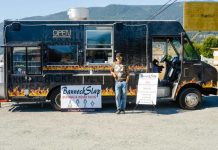
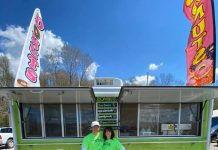

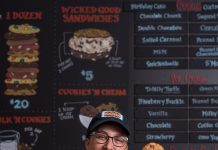

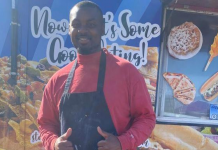

(Photo: Zach Boyden-Holmes/Register file photo)
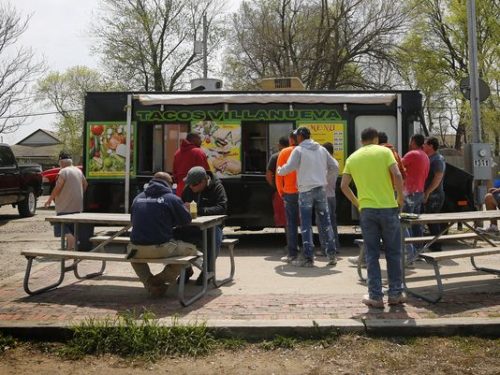
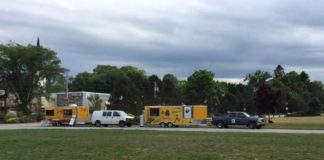
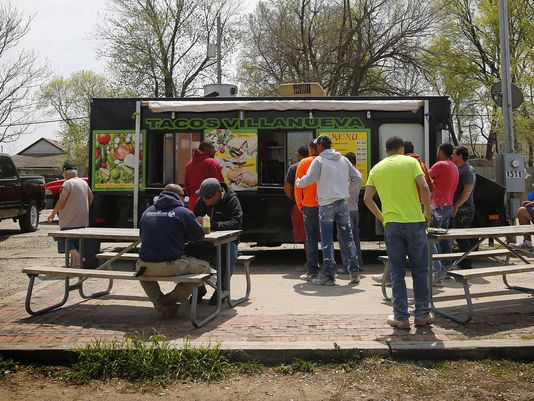
The Tacos Villanueva food truck at 1531 E. Grand Ave. serves customers last May.
(Photo: Zach Boyden-Holmes/Register file photo)
By Timothy Meinch | Des Moines Register
Mobile food trucks will hit downtown streets later this month if the Des Moines City Council gives its final OK to a pilot program Monday night.
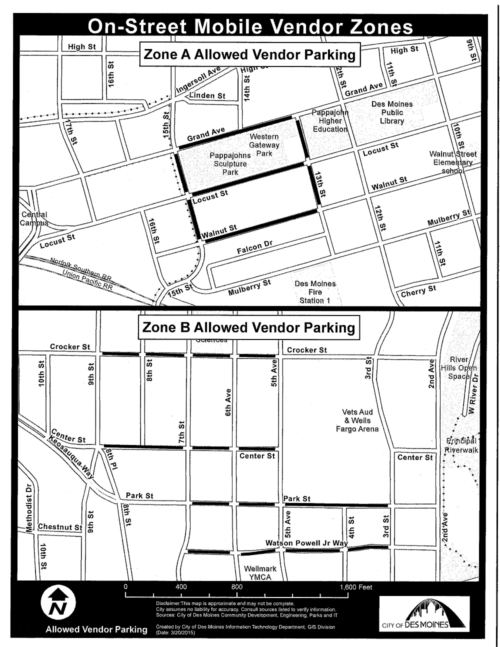
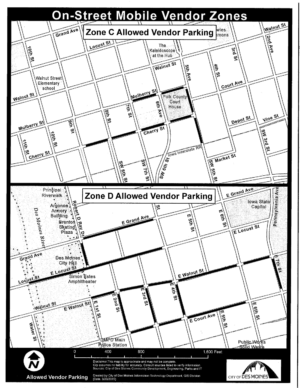
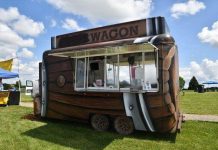
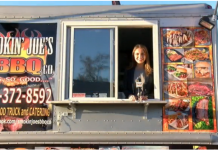
The city plans to establish four zones where vendors can serve culinary creations such as Belgian fries, wood-oven pizzas and Asian-infused tacos.
The trucks will operate directly from metered parking spaces, a model that sets Des Moines apart from some food-truck meccas, including Austin, Texas, and Portland, Ore.
“There is no such thing as street-food vending in Austin,” said Tony Yamanaka, owner of Food Trailers Austin, a company dedicated to the city’s food truck culture.
Daily food truck vendors in Texas’ capital city operate exclusively on private property. Portland has a similar program.
In both cities, vendors negotiate with private property owners for places to set up their mobile businesses. In Austin, monthly rent can run anywhere from $300 to $1,500. That’s in addition to a city permit that costs roughly $300.
Des Moines vendors will play a $900 fee. That includes a six-month permit to operate and a parking meter hood.
“They’re renting prime real estate in the downtown area for their business,” Des Moines assistant to the city manager Kandi Reindl said.
Minneapolis launched a similar on-street approach to food trucks five years ago. It charges $818 in annual fees, but vendors there must feed the meter like any other vehicle.
Still food truck owners in Des Moines have a mix of opinions about the cost to participate in the six-month pilot program.
“The $900 is virtually double what anywhere else in the country is charging for 12 months,” said Zachary Mannheimer, owner of Powered by Fries and co-founder of a new Des Moines food truck association.
Many U.S. cities such as New York, Philadelphia and Pasadena charge less than $500 a year for food truck permits.
In Chicago vendors pay between $700 and $1,000 for a two-year permit. But they must find private property where they can operate or feed the meter.
Some Des Moines operators say the $900 fee the city plans to charge is fair.
“I see the value,” said Ben Norris, co-owner of the Spot food truck. “The price holds up a standard.”
Norris operates the Spot once a week on private property at Walnut and 12th streets in downtown Des Moines. He pays $550 to the city for a license and $450 a year to rent the space. He pays another $550 to the city for a separate license to set up shop once a week at Confluence Brewery.
The city will continue to let food trucks operate on private property as it has in the past. But the pilot program will give vendors access to hundreds of parking spots in the four designated food truck zones.
Hamid Karam, the owner of Mediterranean Grill, is optimistic it will work.
“We’ll be making money if we’re downtown here,” he said.
In Minneapolis there are roughly 80 licensed food trucks, and several operators have gone on to open permanent restaurants, Grant Wilson, the city’s manager of licenses and consumer services, said.
“It’s like a food court of food trucks downtown on certain blocks,” he said. “It’s hugely popular with downtown workers. There are frequently lines with patrons waiting for food.”
Similar atmospheres have sprung up in Austin and Portland, with food truck parks forming around properties where multiple vendors set up shop.
With food trucks limited to four zones, Des Moines could see similar results.
The program, which allows vendors to operate from 5:30 a.m. to 1:30 a.m., will be evaluated after the six-month trial period. It could then become a permanent part of downtown’s dining scene.
The recently formed Legion of Food mobile vendor association says the pilot program also is a chance for operators to figure out what works.
The group, with about 12 members, has goals for the pilot period: identify the best locations and times of day, track and report revenue, identify potential new zones, and continue to back food truck reform in the city.
But the first goal is to get the pilot program approved.
“We’ve invested hundreds of thousands of dollars in our equipment to do this, not knowing if this is going to move forward,” Mannheimer told the City Council two weeks ago.
Councilman Chris Coleman voted against the program. He raised concerns about brick and mortar restaurants and requested a higher fee for food truck vendors.
Councilman Joe Gatto also voiced concerns about the fee, but as a downtown restaurant owner he abstained from the vote.
The second reading passed 5-1. Final approval requires only four yes votes.
But to add some suspense, Mayor Frank Cownie, a backer of the program, is scheduled to miss Monday’s meeting.
D.M. ZONES
• The block surrounding the Pappajohn Sculpture Park and one block south.
• The four blocks west of the Iowa Events Center along Crocker and Center streets, plus a stretch of Park Street and Watson Powell Jr. Way to the south.
• The Locust Street Bridge crossing the Des Moines River, plus several East Village blocks along Grand Avenue, East Walnut Street and East Court Avenue.
• West of the Court Avenue district near the Polk County Courthouse, stretching to west to Ninth Street along Cherry Street.